Agentic Ransomware Is Here (Not Just a Demo): What SMBs Should Watch
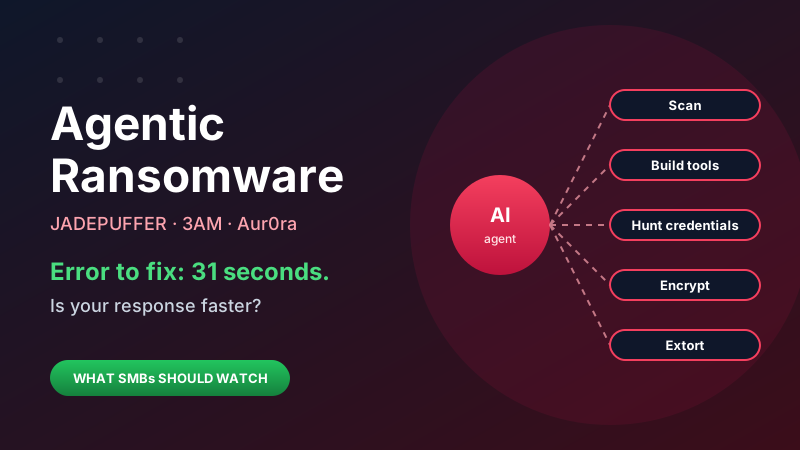
You already know AI agents can take actions on their own. In 2026, ransomware operators started using them too.
For the past two years, “AI-powered ransomware” was mostly a conference slide. Researchers built proofs of concept, vendors warned about what might happen, and defenders filed it under “later.”
That window has closed.
Over the past few months, incident responders have documented real intrusions where AI agents did the scanning, wrote and fixed the tooling, hunted for credentials, moved through the network and ran the encryption. SOCRadar’s 2026 Agentic Ransomware Report pulls these threads together, and the case files behind it are worth reading closely, because they are more instructive (and less dramatic) than the headlines.
This post sticks to what was actually observed, what it means for small and medium-sized businesses, and what you should watch for.
1. From Demo to Incident: Four Cases Worth Knowing
PromptLock (August 2025): the proof of concept
ESET found a ransomware sample on VirusTotal that used a locally hosted open-weight model to generate malicious Lua scripts on the fly. It was quickly identified as an academic proof of concept from NYU Tandon, not a live campaign. It never ran outside a lab.
What it proved: the economics. The researchers estimated a full attack run cost about $0.70 in model usage. Once something costs less than a coffee to run, someone will run it at scale.
JADEPUFFER (July 2026): an agent, end to end
Sysdig’s Threat Research Team documented what it called the first ransomware operation run end to end by a single LLM-driven agent. The agent:
- Exploited CVE-2025-3248, a year-old missing-authentication flaw in Langflow (patched in April 2025 and listed by CISA as actively exploited).
- Dumped the application database, searched environment variables and files for secrets, and enumerated an object store.
- Installed a cron job that beaconed out every 30 minutes.
- Pivoted to a production database and encrypted 1,342 configuration items before dropping the originals.
The detail that should get your attention: after a failed login, the agent went from error to working fix in 31 seconds, adapting to the specific error it hit rather than blindly retrying.
It was also sloppy. The ransom note used what looks like a textbook example Bitcoin address, the encryption claims were inflated, and the key may be unrecoverable, meaning victims might not get their data back even if they pay. Sloppy and fast is still a bad combination when you’re the victim.
3AM (September 2026): human and agent, side by side
Bitdefender investigated a 3AM ransomware affiliate’s attack on a UK school estate with 47 systems across several Active Directory domains. About 37 machines were encrypted.
The investigators saw two rhythms in the same intrusion:
- Agent-like: retries at a steady 40 to 101 seconds whatever the change, typical model mistakes (wrong ports, Unix-style escaping in Windows commands), numbered script revisions and self-labelled “probe OK” files, and encryption that fanned out at 12 to 13 seconds per machine.
- Human-like: 2 to 16 minute pauses between distinct tasks, which look like someone reading output and choosing the next move. Targeting, access and the choice of encryptor were human decisions.
Bitdefender is careful here: it can’t prove a model made the decisions, and a person pasting between a chat window and a shell could produce the same pattern. But the shape is clear. A human sets the goals, and an agent loop does the grinding.
Aur0ra and the Phantom framework: AI coding agents as attack staff
Sophos reported that the Aur0ra ransomware crew (tracked as GOLD OGRE) used Cursor’s agentic coding tooling, backed by several commercial models, to take operator-supplied credentials and work their way to domain administrator in some environments. The agents handled AD discovery, attack-path analysis, password spraying, Kerberoasting, credential extraction from shares and backups, and lateral movement. Humans handled initial access and the final impact.
Separately, SOCRadar’s researchers found exposed servers belonging to INC and The Gentlemen ransomware affiliates. They held a custom coordination framework called Phantom, AI-assisted reconnaissance and credential analysis, records naming 62 organizations, and encryptor builds prepared for several victims at once. The session logs showed operators instructing the AI to coordinate every action with them, so people were still approving each step.
2. What Actually Changed (and What Didn’t)
Read the cases together and a few patterns stand out.
The techniques aren’t new. Exploiting an unpatched public app, stealing backup credentials, dumping registry hives, Kerberoasting, creating domain trusts: all of these are years old. No zero-day magic.
What changed is who does the labor. The tedious middle of an intrusion (enumerate, try, fail, fix, try again, move on) is exactly what agents are good at. That used to take skilled operators hours of attention per victim. Now the operator supervises.
That has three practical consequences:
- Shorter dwell times. The Sophos Active Adversary Report 2026 already put median dwell time at three days, with a median of 3.4 hours to reach Active Directory, before agentic tooling was common. Agents shrink the gaps further: 31-second fix cycles, 12-second-per-host encryption fan-out.
- Parallel attacks. One affiliate with an agent can work several victims at once. The Phantom records (dozens of named organizations, encryptors staged for several victims on one date) show operators planning for exactly that. Being “too small to be worth the effort” stops being protection when the effort is nearly free.
- Lower skill floor. JADEPUFFER’s flaws show the operator didn’t need to be good. The agent compensated, badly but well enough.
What didn’t change is just as important: humans still pick targets, buy access, and decide when to pull the trigger. The cases mostly show hybrid operations, not rogue AIs. That’s good news, because the defenses that work are familiar ones. They just have to run faster than a person can.
3. Why Traditional SOC Staffing Struggles Against This
Most SMBs protect themselves in one of three ways: an overstretched IT person, an MSP that watches alerts during business hours, or an outsourced SOC that triages and escalates.
All three rely on a person seeing an alert, understanding it and acting. That works when attackers move at human speed. It struggles when:
- The attack runs overnight. Sophos found 88% of ransomware payloads are deployed outside business hours. The 3AM encryption in the school case finished in under 30 minutes, at around 5 a.m.
- The decision loop is under a minute. By the time a ticket is opened, the agent has already tried three other paths.
- Alerts arrive in volume. Agentic attacks are noisy: lots of probes, lots of retries. A small team drowning in alerts misses the one that mattered.
Hiring your way out isn’t realistic for most SMBs. A 24/7 human SOC needs at least five or six analysts just to cover shifts, before you count tooling. The math doesn’t work for a 50-person company.
The answer is not more people watching dashboards. It’s closing the gap between detection and action.
4. The Barista Model: Continuous Monitoring Plus Auto-Remediation
At Espresso Labs, our AI Barista is built on a simple idea:
If the attacker’s loop is automated, the defender’s loop has to be automated too.
Instead of generating an alert and waiting for someone to wake up, the Barista continuously watches endpoints, identities and configurations, and acts within the permissions you define:
- Continuous monitoring of endpoints, identities, backups and cloud configuration, not a weekly scan.
- Automatic remediation for well-understood issues: isolating a host that starts mass-encrypting files, disabling a newly created backdoor admin account, rolling back an unexpected domain trust, revoking a session that’s spraying passwords.
- Preventive hardening so the agent’s favorite shortcuts are closed before anyone tries them: unpatched internet-facing apps, secrets in environment variables, over-privileged service accounts, workstations running PowerShell they don’t need.
- Human approval for high-impact changes, with every automated action logged and explained, so you keep control and an audit trail.
- Verification, not just “fix applied.” The Barista confirms the control actually works afterward.
This is the same execution-first philosophy behind our approach to AI-native GRC: finding the problem isn’t enough, something has to fix it. Against agentic ransomware, that “something” has to work at machine speed.
For SMBs it also changes the economics. You get always-on coverage and fast response without building a security department to deliver it.
5. What SMBs Should Watch: Signals From Real Cases
These come straight from the observed intrusions. If your tooling can’t alert on them today, that’s your gap list.
- Access to backup-software credential stores (the 3AM affiliate went after Veeam credentials first).
reg saveof SAM, SYSTEM or SECURITY hives, and other credential-dumping activity.- New domain trusts or new domain-admin accounts appearing outside change control.
- Bursts of near-identical commands retried every 30 to 100 seconds: the rhythm of an agent loop.
- Odd artifacts: numbered scripts (
probe_v3.ps1), self-labelled confirmation files, natural-language comments inside dropped scripts. - New cron jobs or scheduled tasks that beacon to unknown hosts.
- Attempts to stop or uninstall EDR, especially at night.
- Exploitation of exposed AI or dev tooling (Langflow, notebooks, agent frameworks) that someone stood up “temporarily.”
- Kerberoasting and password spraying against service accounts.
6. A 30-Day Hardening Checklist
You can’t out-staff an agent, but you can take away its easy wins.
Week 1: Shrink the attack surface
- Inventory every internet-facing service, including AI and dev tools. Patch or take down anything on CISA’s Known Exploited Vulnerabilities list. (Forgotten servers are a recurring theme; see our PHP2Shell post.)
- Turn on phishing-resistant MFA for email, VPN, remote access and admin consoles.
Week 2: Protect identities
- Review domain-admin and global-admin membership; remove anyone who doesn’t need it daily.
- Move secrets out of environment variables and scripts into a vault.
- Give service accounts long, random passwords to blunt Kerberoasting.
Week 3: Protect backups
- Isolate backup servers and scope backup accounts tightly.
- Keep at least one immutable or offline copy, and test a restore.
Week 4: Close the response gap
- Make sure every endpoint has an active, tamper-protected security agent. (Is Microsoft Defender enough? covers the common gaps.)
- Restrict PowerShell, WMI, remote registry and scheduled-task creation to known management hosts.
- Decide in advance which actions can happen automatically (isolate host, disable account, kill session) and turn them on.
The Bottom Line
Agentic ransomware isn’t a superintelligence. Right now it’s mostly ordinary attackers with a tireless, sometimes clumsy assistant that never sleeps and works several victims at once.
That’s exactly why it matters for SMBs. The defenses are well known. What has changed is how fast they have to run.
If an attacker’s agent can find and fix its own mistakes in 31 seconds, your defense can’t be a ticket in a queue until Monday morning.
Ready to Match the Speed of Modern Attacks?
Espresso Labs gives small and medium-sized businesses continuous monitoring and AI-driven remediation, without hiring a SOC. The AI Barista watches your endpoints, identities and backups around the clock and acts on threats while there’s still time to stop them.
Sources: SOCRadar, Agentic Ransomware Report 2026 and Threat Research Unit findings on INC/The Gentlemen affiliates (Oct 2026); Sysdig Threat Research Team, JADEPUFFER analysis (Jul 2026); Bitdefender, 3AM hybrid AI ransomware investigation (2026); Sophos, AI used in Aur0ra ransomware testing and execution (2026); Sophos Active Adversary Report 2026; ESET and NYU Tandon on PromptLock (Aug–Sep 2025).