AI-Native GRC: Why the Future of Compliance Is Execution, Not Documentation
The next generation of compliance platforms won’t just tell companies what needs to be fixed. They’ll use AI to fix it.
For years, governance, risk, and compliance (GRC) has been a necessary but painful part of running a technology company.
Whether you’re preparing for SOC 2, ISO 27001, HIPAA, or CMMC, the process often looks remarkably similar:
- Endless spreadsheets and documentation.
- Security questionnaires and policy reviews.
- Screenshots and evidence collection.
- Manual tracking of security controls.
- Repeated requests from auditors.
- Engineers pulled away from building products to satisfy compliance requirements.
A new generation of AI-driven GRC platforms is beginning to change this equation.
But we believe the real transformation goes much further than automating paperwork.
The future of compliance is not better dashboards. It’s autonomous execution.
1. The Problem With Traditional Compliance Automation
Platforms like Vanta and Drata helped modernize compliance by connecting to cloud infrastructure, identity providers, and other business systems.
They made it easier to collect evidence, monitor configurations, track compliance requirements, and prepare for audits.
That’s meaningful progress.
However, there’s still a fundamental limitation: identifying a problem isn’t the same as solving it.
A dashboard can tell you that:
- An employee has excessive permissions.
- A laptop is missing an important security configuration.
- A required security policy hasn’t been implemented.
- A vulnerability hasn’t been addressed.
- A compliance control is failing.
But someone still needs to investigate, understand the issue, implement the fix, verify that it worked, and document the result.
That someone is usually an engineer, IT administrator, or security professional.
In other words, traditional compliance automation digitized the workflow but left much of the actual work to humans.
2. The Shift From AI-Assisted to AI-Executed Compliance
Generative AI introduced a new possibility: systems that don’t just process information but can understand requirements, reason about security configurations, and take action.
This changes the architecture of compliance automation.
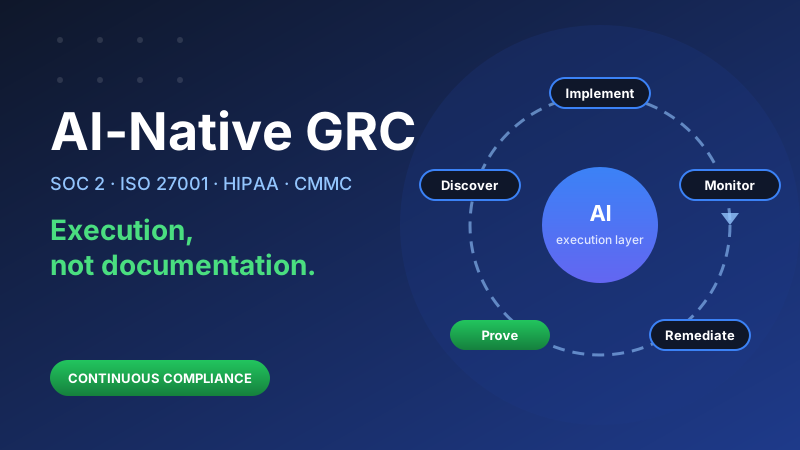
Instead of simply asking whether a company meets a particular requirement, an AI-native platform can:
- Understand: Interpret compliance frameworks and translate requirements into actionable technical controls.
- Discover: Continuously inspect infrastructure, endpoints, identities, and configurations to identify gaps.
- Implement: Execute appropriate remediation workflows and help configure missing controls.
- Enforce: Ensure security policies are consistently applied across the organization.
- Monitor: Continuously validate that controls remain effective.
- Remediate: Detect deviations and take corrective action within defined permissions.
- Prove: Automatically collect, organize, and maintain the evidence required by auditors.
This is a fundamentally different approach.
Instead of giving teams another place to manage compliance tasks, AI becomes an execution layer that helps get the work done.
3. Compliance Should Be Continuous, Not a Last-Minute Project
One of the biggest challenges with SOC 2 Type II and other ongoing certifications is maintaining compliance throughout the observation period.
A company might be fully compliant on the day of its initial assessment, but what happens three months later?
An employee joins. Another leaves. A laptop misses an update. A cloud configuration changes. A security policy becomes outdated.
Compliance is not a static achievement. It’s an ongoing operational requirement.
AI-native compliance makes continuous validation possible.
Rather than waiting for the next audit or manually checking controls every few weeks, an AI-driven platform can continuously monitor the environment, identify deviations, trigger remediation, and maintain an up-to-date evidence trail.
This is particularly important for organizations managing multiple frameworks:
- SOC 2: Access controls, vulnerability management, monitoring, and security policies.
- ISO 27001: Information security controls, risk management, and operational security.
- HIPAA: Technical safeguards and protection of sensitive healthcare information.
- CMMC: Security practices and evidence required by organizations working with the US Department of Defense.
Many of these frameworks share underlying security requirements. AI can help map overlapping controls and eliminate duplicated work.
The result is less administrative overhead and more time spent improving actual security.
4. The Missing Piece: AI That Can Actually Do the Work
At Espresso Labs, this is exactly the problem we’re working to solve.
We believe compliance should move from a software and workflow problem to an AI execution problem.
Our AI Barista is designed around a simple principle:
Don’t just tell customers what’s wrong. Help make it right.
Instead of relying exclusively on dashboards, checklists, and manual workflows, Espresso Labs uses AI to help organizations:
- Identify compliance gaps across their IT and security environments.
- Implement and enforce required security controls.
- Continuously monitor endpoints, identities, and configurations.
- Detect security and compliance issues.
- Automate remediation wherever appropriate.
- Collect and organize audit evidence.
- Maintain ongoing compliance rather than preparing for an audit from scratch.
This approach is particularly valuable for small and medium-sized businesses.
These companies face many of the same compliance requirements as large enterprises, but rarely have the budget for a dedicated security team, compliance officer, and multiple specialized tools.
AI changes the economics.
It allows smaller organizations to achieve a stronger security and compliance posture without building an entire department around maintaining it.
5. Trust and Human Oversight Still Matter
Autonomous compliance does not mean removing humans from the equation.
In fact, the more responsibility we give AI systems, the more important governance becomes.
A reliable AI-native compliance platform needs several foundational capabilities:
- Traceability: Every automated action should be logged, with a clear explanation of what happened and why.
- Evidence integrity: Audit evidence must be connected to verifiable underlying data, configurations, and system activity.
- Human approval: Sensitive changes and high-impact remediation actions should require authorization from designated owners.
- Least privilege: AI agents should operate with only the permissions necessary to perform their assigned tasks.
- Continuous verification: A remediation is not complete simply because an AI agent reports success. The system must verify that the underlying control is actually working.
The goal isn’t to replace accountability. It’s to eliminate repetitive manual work while giving security professionals better visibility and control.
6. The Economics of Compliance Are About to Change
Traditional compliance services and software can be expensive, especially for smaller companies.
Organizations often pay for multiple tools, consultants, auditors, and internal engineering hours just to maintain their compliance posture.
The hidden cost is even greater: engineering time spent managing compliance instead of building the business.
AI-native platforms have the potential to change this equation dramatically.
When AI can perform work that previously required hours of manual effort, companies can achieve:
- Faster compliance readiness.
- Lower operational costs.
- Less engineering overhead.
- Better continuous security monitoring.
- More consistent implementation of security controls.
At Espresso Labs, our objective is to make compliance better, faster, and more affordable through AI.
Not by cutting corners, but by fundamentally changing how the work gets done.
7. What’s Next: From GRC Software to Autonomous Security Operations
The emergence of AI-driven GRC is part of a much larger transformation.
We’re moving from software that helps people manage security to intelligent systems that can actively operate and improve security environments.
The next generation of compliance platforms will not be judged by how many integrations they offer or how many compliance tasks appear as completed on a dashboard.
They’ll be judged by a much simpler question:
How much of the actual security and compliance work can they reliably execute?
We believe that’s where the industry is heading.
And that’s what we’re building at Espresso Labs.
Ready to Make Compliance Less Painful?
Espresso Labs helps companies automate security and compliance with AI — from identifying gaps and implementing controls to continuous monitoring, remediation, and audit evidence collection.
Whether you’re preparing for SOC 2, ISO 27001, or CMMC, there’s a better way to get compliant and stay compliant.
Spend less time managing compliance. Spend more time building your business.