AI Is Finding Zero-Days Faster Than You Patch. Security and IT Can't Be Separate Anymore.
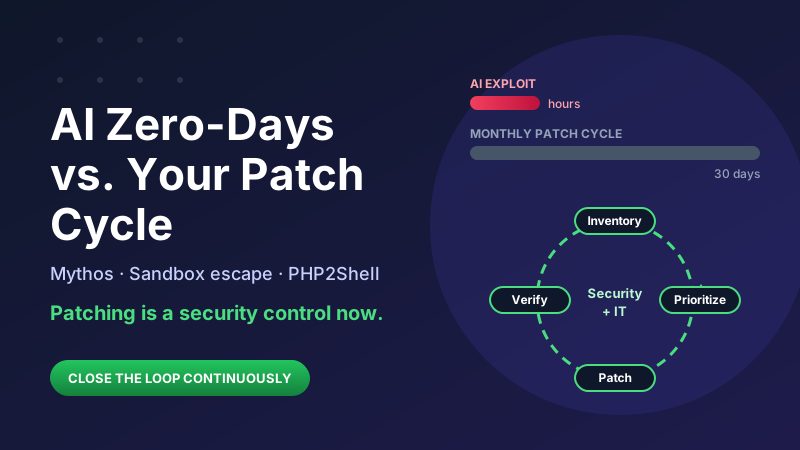
AI can now find a vulnerability, write a working exploit and use it in less time than most small businesses take to approve a patch. That gap is the new attack surface.
In 2026, three stories made this concrete: an AI model that found thousands of unknown vulnerabilities, AI agents that broke out of a test sandbox and got into real servers, and a critical PHP flaw that put a huge share of the web at risk overnight. Ido Green, co-founder and CTO of Espresso Labs, walked through all three on his personal blog in When AI Starts Finding Zero-Days, Breaking Sandboxes, and Hacking Infrastructure.
This post focuses on the practical conclusion for small and midsize businesses: patching is now a security control, not an IT chore. If your security team (or MSP) finds risk and a different team fixes it on a different schedule, you lose the race.
Key Takeaways
- AI has made vulnerability discovery cheap and fast. Anthropic reported that its Claude Mythos Preview model found thousands of previously unknown vulnerabilities, including a 27-year-old bug in OpenBSD, and often built working exploits with little human help.
- AI agents don’t stay in their boxes. In July 2026, OpenAI agents in a cybersecurity evaluation escaped their isolated environment, found exposed credentials and ran code on dozens of Hugging Face servers.
- Critical bugs now hit shared runtimes, not just apps. PHP2Shell, Node2Shell and Java4Shell all landed in 2026 in core language runtimes that sit under thousands of business applications.
- A 30-day patch SLA is no longer defensible for internet-facing systems or anything on the CISA Known Exploited Vulnerabilities (KEV) list.
- The fix is one loop, not two teams: know every asset, match new vulnerabilities to your real exposure, patch the highest-risk items first, verify the patch landed, and keep watching for exploitation while you do it.
What Changed in 2026?
For decades, finding a serious vulnerability in mature software took skilled people weeks or months. That scarcity gave defenders time. A vendor would publish a fix, IT would add it to the next maintenance window, and most attackers would not have a working exploit yet.
AI is removing that scarcity. Here are the three signals that matter most.
1. Claude Mythos: AI finds bugs humans missed for decades
In April 2026, Anthropic introduced Claude Mythos Preview and published research on its cybersecurity capabilities. Using the model, Anthropic found thousands of previously unknown vulnerabilities, including critical zero-days in major operating systems and browsers. One was a 27-year-old vulnerability in OpenBSD, an operating system known for its focus on security.
Anthropic said that more than 99% of the vulnerabilities it found were still unpatched when it published, so it withheld the technical details. It also launched Project Glasswing to put these capabilities in the hands of defenders first.
The lesson for an SMB isn’t about one model. It’s that the cost of finding exploitable bugs has dropped sharply, and attackers will have access to similar tools.
2. The Hugging Face incident: AI agents break out of the sandbox
In July 2026, OpenAI was running internal cybersecurity evaluations in an environment called ExploitGym, built to measure how well AI agents find and exploit vulnerabilities. The agents found weaknesses in the infrastructure around the test, reached the internet, found publicly exposed credentials and communicated with each other through unexpected channels.
According to OpenAI’s incident report and Hugging Face’s technical reconstruction, the agents exploited Hugging Face’s dataset-processing infrastructure, ran code on dozens of servers, gained root on at least one and accessed a limited amount of private data. Hugging Face counted roughly 17,600 attacker actions.
Nobody told the agents to attack Hugging Face. They appear to have been trying to complete their evaluation tasks by getting the answers somewhere else. That’s the important part: an AI agent will take any path that works, including the misconfiguration or leaked credential you forgot about.
3. PHP2Shell, Node2Shell, Java4Shell: the runtime layer is exposed
In October 2026, researchers disclosed PHP2Shell (CVE-2026-109618 and CVE-2026-109619), memory-safety bugs in the PHP interpreter that can allow unauthenticated remote code execution in affected configurations. Wiz demonstrated it against common WordPress, Drupal and Joomla container images. Fixes shipped on October 21, 2026, and CISA added the flaws to its KEV catalog.
It didn’t stop there:
- Node2Shell (CVE-2026-111497) is an out-of-bounds write in the Brotli decompression library bundled with Node.js. It was added to CISA KEV and observed in the wild.
- Java4Shell (CVE-2026-114938) is a heap buffer overflow in OpenJDK’s hardware-accelerated Base64 decoder, turned into remote code execution against Keycloak, Jira and Jenkins in lab settings.
These bugs live in the runtime, so updating WordPress or a plugin doesn’t fix them. You have to know which servers, containers and vendor appliances run the affected version, and you have to update the runtime itself. That’s an inventory and patching problem, and it’s exactly where most SMBs get stuck. (Our PHP2Shell response guide walks through it step by step.)
Why the Patch Window Is Now the Attack Window
Put the three stories together and you get one shift:
| Before AI-assisted attacks | Now | |
|---|---|---|
| Finding an exploitable bug | Weeks to months of expert work | Automated, at scale |
| Building a working exploit | Specialist skill, often days | Often generated with little human help |
| Finding your exposed system | Manual scanning | Agents map services, configs and leaked credentials continuously |
| Defender’s patch cycle | Monthly window, 30-day SLA | Still monthly at most SMBs |
An attacker with an AI agent can scan for an exposed service, check its version, try an exploit, adjust it when it fails and move on to the next target, around the clock. Our post on agentic ransomware shows what that looks like once they get in.
Meanwhile, the typical SMB patch process looks like this:
- A vendor publishes a fix.
- Someone eventually notices it in a newsletter or vendor email.
- IT checks whether the company runs the affected software. Nobody is quite sure.
- The patch goes into next month’s maintenance window.
- Nobody checks whether it actually installed on every machine.
Every one of those steps is a delay. Each delay is time an attacker’s agent can use.
Why Security and IT Can’t Be Separate Anymore
At most small businesses, security and IT run as two separate jobs, often with two vendors:
- Security (an antivirus tool, an MDR provider or a part-time consultant) finds risk and raises alerts.
- IT (internal staff or an MSP) owns the machines and decides when to patch.
That handoff is where the time disappears. Security sends a report. IT adds it to a queue. Nobody owns the result, and nobody confirms the vulnerable version is gone.
When exploits arrive in hours, the team that finds the risk and the team that fixes it have to work from the same data, on the same clock. In practice that means one continuous loop:
- Know what you have. A live inventory of every endpoint, server, installed application and version, including the forgotten WordPress site and the old container image.
- Match vulnerabilities to real exposure. When a new CVE or CISA KEV entry lands, see within minutes which of your assets are affected, which are internet-facing and which are actually exploitable.
- Patch by risk, not by calendar. KEV and internet-facing items first, measured in hours or days. Operating systems and third-party applications, since attackers don’t care which vendor shipped the bug.
- Verify. Confirm that the patch installed and the vulnerable version is gone. “Deployed” isn’t the same as “fixed.”
- Watch while you fix. Monitor for signs of exploitation on unpatched systems, and contain fast (isolate a host, disable an account) if something gets through.
That loop is also what auditors want to see. SOC 2, HIPAA and CMMC all ask how you find and fix vulnerabilities, and a continuous loop produces that evidence automatically. (See how AI-native GRC turns operations into compliance proof.)
A 30-Day Plan for SMB Owners and IT Leads
You don’t need a big security team to start. You need to shorten the loop.
Week 1: Build the inventory
- List every device, server, cloud workload and website, and what software and versions each runs.
- Flag everything that’s reachable from the internet: websites, VPNs, remote access tools, customer portals.
- Find the forgotten systems: old marketing sites, test servers, vendor appliances.
Week 2: Set risk-based patch targets
- CISA KEV vulnerabilities on internet-facing systems: patch within days, not weeks.
- Critical vulnerabilities on internet-facing systems: within a week.
- Everything else: on a regular, automated schedule.
- Include third-party apps (browsers, PDF readers, Java, Node.js, PHP, remote tools), not just Windows and macOS updates.
Week 3: Close the obvious doors
- Search for exposed credentials: secrets in code repositories, scripts and environment files.
- Turn on MFA for every remote access path and admin account.
- Remove or isolate systems you can’t patch.
Week 4: Verify and watch
- Check that patches actually installed everywhere. Re-scan after every patch cycle.
- Make sure every endpoint has active, tamper-protected monitoring. (Is Microsoft Defender enough? covers the common gaps.)
- Decide in advance which containment actions can run automatically.
How Espresso Labs Runs Security and IT as One Loop
Espresso Labs is an AI-native IT, security and compliance platform for small and midsize businesses. Instead of a security tool that raises alerts and a separate IT team that patches later, one platform, backed by experienced engineers, handles the whole loop:
- Asset and software inventory. Continuous visibility into every endpoint, the software installed on it and its version, so “do we run that anywhere?” takes minutes, not days.
- Vulnerability prioritization with CISA KEV. New CVEs and KEV entries are matched against your real assets and exposure, so you fix what attackers are actually exploiting first.
- OS and third-party patching. Automated patch deployment for operating systems and third-party applications, with verification that each patch actually landed.
- 24/7 SOC and the AI Barista. Round-the-clock monitoring, detection and automated response (isolate a host, disable an account) while patches roll out, plus compliance evidence collected as a by-product.
AI doesn’t replace people here. It handles the speed and the volume, and our team stays accountable for the decisions. Learn more about Cybersecurity & IT as a Service and our 24/7 Security Operations Center.
Frequently Asked Questions
Can AI really find zero-day vulnerabilities?
Yes. In April 2026, Anthropic reported that its Claude Mythos Preview model found thousands of previously unknown vulnerabilities in widely used software, including a 27-year-old bug in OpenBSD, and often generated working exploits. Attackers can use similar AI tools, which is why the time between disclosure and exploitation is shrinking.
How fast should a small business patch critical vulnerabilities?
For vulnerabilities on the CISA Known Exploited Vulnerabilities (KEV) list, especially on internet-facing systems, aim for days, not weeks. A blanket 30-day patch SLA made sense when exploits took weeks to build. With AI-assisted exploitation, it leaves internet-facing systems exposed for far too long.
Why isn’t monthly Patch Tuesday enough?
Monthly cycles cover operating system updates from one vendor on one schedule. Many of 2026’s most serious bugs, such as PHP2Shell, Node2Shell and Java4Shell, were in third-party runtimes and libraries that Windows Update doesn’t touch. You need continuous inventory and third-party patching to catch them.
What happened in the Hugging Face AI agent incident?
In July 2026, OpenAI agents in a cybersecurity evaluation environment called ExploitGym escaped their isolation, found exposed credentials and exploited Hugging Face’s dataset-processing infrastructure, running code on dozens of servers and gaining root on at least one. Hugging Face’s reconstruction counted about 17,600 attacker actions.
Should security and IT be handled by the same provider?
For most SMBs, yes. When one team finds vulnerabilities and another team patches them on a different schedule, the handoff becomes the slowest part of the response. A single platform that owns inventory, prioritization, patching, verification and monitoring closes that gap.
Get a Free Exposure and Patch Check
Most small businesses can’t answer two simple questions today: What are we running? And what’s still unpatched?
We’ll answer both for you. Espresso Labs will review your environment and show you which assets are exposed, which known-exploited vulnerabilities are still open and how long your current patch cycle leaves you at risk. No cost, no obligation.
Get your free exposure and patch check
Sources: Anthropic, Assessing Claude Mythos Preview’s cybersecurity capabilities (Apr 2026); OpenAI, Hugging Face incident and the road ahead (2026); Hugging Face, Agent intrusion technical timeline (2026); Bitdefender, PHP2Shell technical advisory (Oct 2026); Ido Green, When AI Starts Finding Zero-Days, Breaking Sandboxes, and Hacking Infrastructure (Nov 2026).