The Best Compliance Software: A Comparison of Top Compliance Management Solutions
Quick Answer: What Is the Best Compliance Software?
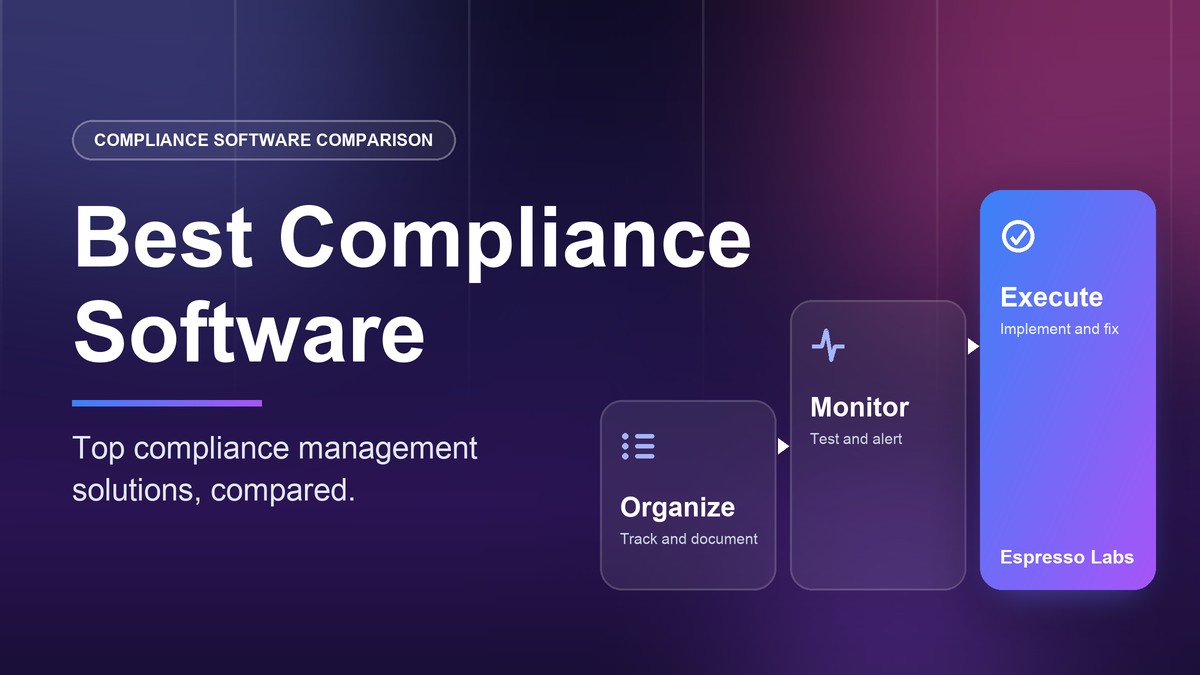
The best compliance software depends on whether your business needs to manage compliance, monitor security controls, or actually implement and maintain them. Vanta, Drata, Secureframe, Sprinto, and Hyperproof help organizations organize compliance programs, automate evidence collection, and track security controls. Espresso Labs takes a different approach: it combines AI-powered compliance management with managed cybersecurity and IT operations to help implement, enforce, monitor, and remediate controls—not simply report what needs attention.
What Is Compliance Software?
Compliance software helps organizations meet, demonstrate, and maintain adherence to industry standards, cybersecurity frameworks, and regulatory requirements.
For businesses handling sensitive customer information, compliance management is increasingly essential for meeting customer expectations, qualifying for contracts, and managing cybersecurity risks.
Common IT and cybersecurity compliance frameworks include:
- SOC 2: Security and other trust services criteria commonly used by technology companies and service providers.
- CMMC: Cybersecurity Maturity Model Certification requirements for applicable Department of Defense contractors and subcontractors.
- ISO 27001: An international standard for information security management systems.
- HIPAA: Security and privacy requirements applicable to covered healthcare entities and business associates.
- PCI DSS: Security requirements for organizations handling payment card information.
- NIST SP 800-171: Security requirements for protecting Controlled Unclassified Information in nonfederal systems, when applicable.
This isn’t a niche category. The global GRC software market was valued at roughly $21 billion in 2025 and is projected to reach $23.3 billion in 2026, growing to about $39 billion by 2031 at a compound annual growth rate of nearly 11%, according to Mordor Intelligence. That growth reflects how many organizations are now expected to prove, not just claim, that their security controls work.
Traditional compliance management software primarily helps organizations organize these requirements, map them to controls, track implementation, and collect evidence.
Modern compliance automation platforms go further, integrating with cloud environments, endpoint management systems, identity providers, and other IT infrastructure to monitor certain controls automatically.
But there is an important distinction that organizations should understand before choosing a compliance management solution:
Knowing that a security control is failing is not the same as fixing it.
And for many organizations, fixing and maintaining controls is where most of the work—and expense—actually begins.
The Three Types of IT Compliance Management Software
Not all compliance platforms solve the same problem. Understanding the differences can help avoid purchasing software that adds another layer of work rather than reducing it.
Category 1: Traditional GRC and Compliance Management Software
Purpose: Organize and document compliance.
Traditional governance, risk, and compliance (GRC) platforms provide a central location for managing policies, risks, controls, assessments, and audit documentation.
Typical capabilities include:
- Compliance framework libraries
- Policy and procedure management
- Risk assessments
- Control mapping
- Task assignment
- Audit preparation
- Compliance dashboards
These systems help answer: What do we need to do, who is responsible, and what is our current compliance status?
They are valuable for maintaining an organized compliance program, but implementing the underlying cybersecurity controls generally remains the responsibility of the organization’s IT and security teams.
Category 2: Compliance Automation and Continuous Monitoring Software
Purpose: Reduce manual compliance tracking and evidence collection.
Compliance automation platforms integrate with existing IT and security systems to automatically verify certain controls and collect supporting evidence.
Typical capabilities include:
- Continuous or scheduled compliance checks
- Automated evidence collection
- Cloud and identity integrations
- Security configuration monitoring
- Compliance alerts
- Remediation workflows
- Auditor collaboration
These platforms help answer: Are our controls operating as expected, and can we prove it?
Some offer AI-assisted remediation, automated workflows, and direct integrations that can perform limited corrective actions. The scope of those capabilities varies by product, integration, and configuration.
However, organizations generally remain responsible for operating the security infrastructure and addressing controls outside the platform’s automation coverage.
Category 3: Operational and Agentic Compliance Platforms
Purpose: Implement, enforce, and continuously maintain compliance.
Operational compliance platforms extend beyond governance and monitoring into the day-to-day execution of security and compliance activities.
These capabilities can include:
- Deploying and configuring cybersecurity tools
- Enforcing security policies
- Managing endpoints and cloud environments
- Monitoring and responding to security events
- Performing vulnerability assessments
- Executing remediation playbooks
- Collecting and organizing audit evidence
- Escalating complex issues to human experts
These systems address a broader question: Can the compliance platform actually do the work needed to keep our organization secure and audit-ready?
This is the approach Espresso Labs is building around AI-powered cybersecurity, IT operations, and compliance management.
Top Compliance Software Solutions Compared
Several established compliance management platforms help organizations address security frameworks, automate documentation, and prepare for assessments.
The following comparison focuses specifically on IT and cybersecurity compliance rather than financial or enterprise-wide regulatory compliance.
Compliance Software Comparison Table
| Compliance software | Primary focus | Key capabilities |
|---|---|---|
| Vanta | Compliance automation and trust management | Framework mapping, automated evidence collection, control monitoring, audit workflows |
| Drata | Continuous compliance and trust management | Automated testing, evidence collection, continuous monitoring, remediation workflows |
| Secureframe | Compliance readiness and automation | Policy management, framework mapping, automated evidence, AI remediation guidance |
| Sprinto | Continuous compliance monitoring | Control testing, evidence collection, drift detection, remediation workflows |
| Hyperproof | Compliance operations and GRC | Multi-framework management, control mapping, risk management, evidence tracking |
| Espresso Labs | Operational cybersecurity and compliance | GRC, security tooling, control implementation, continuous monitoring, remediation, evidence collection |
The most important consideration is not simply which platform supports the most frameworks. It is how much of your compliance workload the solution actually eliminates.
1. Vanta
Vanta is an established compliance automation platform used by organizations pursuing security certifications and attestations.
Vanta connects with cloud infrastructure, identity providers, developer tools, and other business systems to monitor security controls and automate evidence collection.
Key capabilities
- SOC 2, ISO 27001, and other security frameworks
- Automated compliance checks
- Continuous control monitoring
- Evidence collection through integrations
- Policy and risk management
- AI-assisted remediation guidance
- Auditor collaboration and trust management
Vanta’s monitoring and automation capabilities can significantly reduce the administrative burden of compliance management.
For organizations with an established IT and cybersecurity team, this approach can work well: Vanta identifies gaps, organizes evidence, and supports the team responsible for addressing the findings.
What buyers should consider: Vanta provides monitoring, guidance, and remediation capabilities, but it should not automatically be treated as a substitute for the operational security systems and personnel needed to implement and maintain every required control.
For example, evidence that an endpoint is protected depends on the underlying endpoint security and management systems, not simply the compliance dashboard.
2. Drata
Drata focuses on automating security compliance and providing continuous visibility into control effectiveness.
Its integrations help organizations collect evidence, monitor controls, manage remediation activities, and coordinate audits.
Key capabilities
- Continuous compliance monitoring
- Automated evidence collection
- Security and cloud integrations
- Multi-framework compliance management
- Control ownership and remediation tracking
- AI-assisted compliance workflows
- Auditor collaboration
Drata emphasizes continuously updating evidence and identifying compliance drift rather than treating compliance as an annual documentation exercise.
This approach can be useful for organizations managing SOC 2 or multiple overlapping security frameworks.
What buyers should consider: Automated collection and control testing can substantially reduce compliance overhead, but buyers should evaluate which underlying controls Drata directly operates and which require action through existing tools, integrations, or internal teams.
3. Secureframe
Secureframe provides compliance automation capabilities designed to simplify security readiness and ongoing compliance management.
Secureframe supports common security frameworks and offers capabilities for companies preparing for federal cybersecurity requirements, including CMMC.
Key capabilities
- Compliance framework mapping
- Policy and documentation management
- Automated evidence collection
- Continuous control monitoring
- Security configuration checks
- AI-assisted documentation and remediation guidance
- CMMC-specific workflows and documentation
Secureframe’s CMMC capabilities include SSP and POA&M support, SPRS scoring, control monitoring, and integrations with relevant cloud environments.
What buyers should consider: Generating an SSP, identifying a failed control, or providing remediation guidance is not equivalent to implementing that control across an organization’s endpoints, users, cloud services, and network infrastructure.
Organizations should establish which controls Secureframe or its associated services can implement directly and what work remains with their IT team or managed service provider.
4. Sprinto
Sprinto focuses on continuous compliance monitoring and automation.
Sprinto integrates with IT systems to evaluate controls, identify configuration drift, automate evidence collection, and coordinate remediation.
Key capabilities
- Continuous control monitoring
- Automated evidence collection
- Compliance dashboards
- Cloud and identity integrations
- Configuration drift detection
- Remediation workflows
- Multi-framework compliance tracking
Sprinto provides automation intended to reduce manual compliance activities and keep evidence current between audits.
What buyers should consider: Sprinto can detect compliance issues and automate aspects of the associated workflow. However, organizations should examine whether remediation means notifying an owner, initiating an automated workflow, or actually correcting the security configuration in the underlying system.
These are different levels of operational automation.
5. Hyperproof
Hyperproof provides a centralized environment for managing compliance programs, controls, evidence, and risk.
Its framework management and control-mapping capabilities help organizations coordinate multiple compliance requirements.
Key capabilities
- Compliance framework management
- Policy and control tracking
- Automated evidence collection
- Risk management
- Audit collaboration
- Control monitoring
- Cross-framework mapping
Hyperproof is relevant for organizations that need to coordinate multiple compliance programs and manage control ownership across teams.
What buyers should consider: Hyperproof’s compliance operations capabilities help organize and automate governance activities. Buyers looking for a fully managed cybersecurity and IT operation should also evaluate the underlying tools and resources needed to implement the controls being tracked.
Espresso Labs: Compliance Software That Actually Does the Work
Most compliance management solutions begin with a dashboard.
They tell you which controls are passing, which requirements need attention, and what evidence is missing.
But what happens next?
Someone still needs to configure the firewall, deploy endpoint protection, enforce MFA, investigate suspicious activity, run vulnerability scans, remediate findings, and produce evidence.
For small and mid-sized businesses, that often means hiring additional IT or security personnel, paying a managed service provider, or purchasing an assortment of security tools and integrating them with the compliance platform.
Espresso Labs approaches compliance management from the opposite direction: instead of starting with the dashboard, it starts with the work that needs to be done.
We don’t just tell you what needs to be done. We do it for you.
Espresso Labs combines AI agents, integrated cybersecurity tools, and experienced human professionals to help organizations implement, monitor, and maintain the IT and security controls required for compliance.
Rather than simply identifying gaps, Espresso Labs helps close them and maintain the resulting controls.
The goal: a virtual cybersecurity and compliance team that operates continuously, without the cost and complexity of building one internally.
Learn more about Espresso Labs’ AI-powered cybersecurity and compliance platform, or see a direct comparison in Espresso Labs vs. Vanta and Drata.
How Espresso Labs Is Different
1. Compliance implementation, not just compliance tracking
Traditional compliance management software can identify that a device does not have disk encryption enabled.
Espresso Labs can help implement and enforce the relevant endpoint security configuration.
The same principle applies to:
- Endpoint protection and anti-malware
- Device security and configuration management
- Access controls and MFA
- Firewall configurations
- Vulnerability scanning
- Security monitoring
- User access management
The objective is to turn compliance requirements into operational controls rather than leaving them as tasks on a dashboard.
2. Continuous monitoring backed by action
Security and compliance are not static.
An employee installs unauthorized software. An administrator accidentally disables a security control. A device falls behind on critical patches.
Traditional compliance monitoring may identify these problems and create alerts or remediation tasks.
Espresso Labs combines monitoring with AI-assisted security operations and remediation playbooks, helping investigate events and take corrective action where supported and authorized.
Human security experts remain involved for complex investigations, oversight, and decisions that require professional judgment.
3. Cybersecurity and compliance in one system
Many organizations purchase a GRC platform and then separately acquire endpoint security, device management, vulnerability scanning, monitoring, and incident response services.
Espresso Labs brings these capabilities together within a unified service.
This reduces the need for customers to purchase, configure, integrate, and operate numerous disconnected products.
It also creates a more direct connection between the security controls being operated and the evidence needed to demonstrate compliance.
4. Automated evidence collection
Compliance assessments require more than proving that a security control exists.
Organizations may need evidence showing that it operated effectively during the applicable assessment period.
Espresso Labs helps automate the collection and organization of evidence generated by security operations, including monitoring, investigations, remediation, and recurring control activities.
This reduces dependence on manual screenshots, spreadsheets, and last-minute evidence requests.
5. Built for organizations without large security teams
A large enterprise may have dedicated security engineers, compliance managers, IT administrators, and incident response personnel.
A 20-person company probably does not.
Yet smaller organizations can face substantial cybersecurity requirements when pursuing SOC 2, handling sensitive healthcare information, or working with federal contractors.
Espresso Labs is designed to help these businesses obtain and maintain the required capabilities without building a large internal security and compliance department.
Compliance Dashboard vs. Operational Compliance: A Practical Example
Consider a common compliance requirement:
All company-managed endpoints must have approved security protection installed, enabled, and operating effectively.
Here’s how different approaches handle the requirement.
Traditional compliance management
- Creates a control requiring endpoint protection.
- Assigns an employee responsibility for implementing it.
- Stores the applicable policy and supporting documentation.
- Tracks whether the task has been completed.
The IT team must implement and maintain the actual protection.
Compliance automation software
- Connects to an endpoint security or management system.
- Checks whether devices have appropriate protection.
- Flags devices that fail the compliance test.
- Collects supporting evidence automatically.
- Initiates a remediation workflow.
Depending on the product and integration, an IT administrator may still need to correct the underlying issue.
Operational compliance with Espresso Labs
- Deploys and manages endpoint protection as part of the security service.
- Continuously monitors endpoint security status.
- Identifies missing protection or control failures.
- Initiates supported corrective actions or escalates to a human expert.
- Collects operational evidence for compliance assessments.
Implementation, monitoring, remediation, and evidence collection are connected in the same operational process.
This distinction becomes increasingly important as organizations grow and their compliance requirements expand.
What Features Should You Look for in Compliance Management Software?
When evaluating compliance software, consider the entire compliance lifecycle—not just the functionality shown in a product demonstration.
1. Framework support
Does the platform support your specific security requirements?
Organizations pursuing CMMC should verify that the product supports the applicable CMMC level, assessment objectives, SSP documentation, POA&M management, and evidence requirements. Our CMMC compliance software buyer’s guide goes deeper.
Organizations pursuing SOC 2 should evaluate its ability to support the selected Trust Services Criteria and the operating period for a Type II examination. See our SOC 2 compliance software comparison for more.
2. Control implementation
Can the solution implement technical controls, or does it simply track them?
Ask who will configure your security tools, manage endpoints, enforce MFA, remediate vulnerabilities, and maintain access controls.
A compliance dashboard may automate tracking while leaving the majority of operational work unchanged.
3. Continuous monitoring
Does the platform periodically collect evidence, continuously monitor security controls, or both?
How quickly does it detect configuration changes?
Does it monitor only connected applications, or can it also address endpoints, networks, identity systems, and security events?
4. Remediation and incident response
What happens when a control fails?
Does the software create a ticket, generate instructions, execute a corrective action, or escalate to an experienced security professional?
Ask vendors to demonstrate an actual remediation from detection through resolution.
5. Evidence collection
Can the platform automatically collect evidence from your systems?
Can it demonstrate not only that a control passed once, but that the control operated over the required assessment period?
Does it preserve evidence of investigations, exceptions, reviews, and remediation activities?
6. Human expertise
AI and automation can eliminate substantial amounts of repetitive security and compliance work.
But they should not eliminate oversight.
Look for clearly defined processes for human review, escalation, incident handling, and approval of potentially disruptive actions.
7. Total cost of compliance
The software subscription is only one part of the cost.
Organizations should also consider:
- Security tools and infrastructure
- IT administration
- Managed security services
- Compliance consultants
- Employee security training
- Vulnerability assessments and penetration testing
- Audit or certification fees
- Ongoing remediation and maintenance
The lowest-priced compliance dashboard may not deliver the lowest total cost of compliance.
How AI Is Changing Compliance Management
AI is beginning to change not only how compliance programs are documented, but how cybersecurity and compliance work is performed.
Historically, organizations relied heavily on people to review alerts, investigate exceptions, update documentation, track remediation, and assemble evidence.
Compliance automation software reduced some of this workload through integrations and automated testing.
Agentic AI creates opportunities to go further.
Rather than simply generating an alert, an AI-powered system can potentially classify an event, evaluate the relevant security context, select an approved response, execute a playbook, verify the outcome, and record evidence.
For example:
From security event to compliance evidence
- Detect: A security monitoring system identifies suspicious activity or a failing control.
- Classify: Specialized AI models help determine the type and severity of the event.
- Reason: An AI agent evaluates the context and determines an appropriate response within defined policies.
- Act: The system executes an authorized remediation playbook or escalates to a security professional.
- Verify: The system checks whether the intended corrective action succeeded.
- Document: Evidence of detection, investigation, response, and resolution is retained for compliance purposes.
This approach can reduce the time between identifying a compliance issue and correcting it.
It also addresses a fundamental weakness in traditional compliance management: the separation between discovering a problem, assigning it to someone, and actually solving it.
The future of compliance management is not simply better visibility. It is connecting visibility to execution.
Conclusion: The Best Compliance Software Should Reduce the Work, Not Just Organize It
The compliance management software market has evolved considerably.
Traditional GRC platforms replaced spreadsheets with structured compliance programs.
Compliance automation platforms added integrations, continuous monitoring, and automated evidence collection.
Today, AI creates an opportunity to take the next step: connecting compliance management directly to the implementation, enforcement, and remediation of security controls.
The distinction is especially important for small and mid-sized organizations that lack the resources to build dedicated cybersecurity and compliance teams.
Before investing in another compliance platform, ask one simple question:
Are we buying software that tells us what needs to be done, or a solution that actually helps us do it?
Compliance doesn’t need another dashboard. It needs execution.
Espresso Labs acts as your AI-powered cybersecurity and compliance team, helping implement security controls, continuously monitor your environment, remediate issues, and automate the collection of audit evidence.
From SOC 2 and CMMC to ISO 27001 and HIPAA, we help businesses simplify cybersecurity and compliance without building an expensive internal security operation.
Stop managing compliance tasks. Start getting them done.
Explore Espresso Labs’ cybersecurity and compliance solutions →