Espresso Labs vs. NinjaOne and Datto RMM
NinjaOne and Datto RMM hand an IT team a console to operate. Espresso Labs is an autonomous, AI-powered platform that runs IT, security, and compliance for you.
A Tool You Operate vs. A Service That Operates Itself
NinjaOne and Datto RMM are remote monitoring and management platforms. They give an IT team a single console to deploy patches, push scripts, remote into devices, and route alerts into a ticket queue. That console is genuinely useful — it's the reason RMM tools replaced logging into machines one by one.
But an RMM is still a tool, not a team. Someone has to configure the policies, decide what a script does, watch the alert queue, and work the tickets. The platform surfaces the work — it doesn't do the work. You still need an in-house IT person or an MSP sitting behind the console every day.
Espresso Labs is built differently. It's an autonomous, AI-powered platform that is the IT and security team — detecting, triaging, and resolving issues on its own, backed by a full AI-powered SOC that watches your environment around the clock. You're not handed a better console. You're handed a program that runs itself.
From Regulatory Control to Continuous Compliance — In One Platform
An RMM manages endpoints. It has no concept of a CMMC control, a SOC 2 requirement, or a HIPAA safeguard — mapping your environment to a framework is a project you run separately, usually in a spreadsheet or a GRC tool bolted on afterward.
Espresso Labs closes that gap inside the same platform that manages your devices. Every regulatory control is mapped to a concrete playbook, implemented directly on your environment, and then enforced and monitored continuously — so compliance isn't a side project, it's a byproduct of the platform doing its job.
What Ninja and Datto RMM Actually Do
Both platforms are strong at what they were built for: giving an IT operator remote visibility and control over a fleet of endpoints. That typically includes:
- •Remote monitoring, remote access, and patch deployment across endpoints
- •Scripting and automation policies that a technician builds and maintains
- •Alerting and ticketing when a device or agent reports a problem
- •Integrations with third-party AV/EDR, backup, and documentation tools
What they assume is a human operator on the other end — someone triaging every alert, running every script, and deciding what "resolved" means. There's no autonomous decision-making and no SOC watching for threats; the platform waits for a person to act. And neither is built around a compliance framework — they manage devices, not controls.
What Espresso Labs Actually Does
Espresso Labs replaces the console-and-operator model with an autonomous platform that manages, secures, and monitors your environment on its own:
- •AI agent detects, triages, and resolves IT and security events without waiting on a technician
- •Full AI-powered SOC monitors every device and user 24/7 and responds to threats in real time
- •Complex issues escalate instantly to a human expert — no ticket sitting in a queue
- •No console to configure — the service is delivered outcome-first, not tool-first
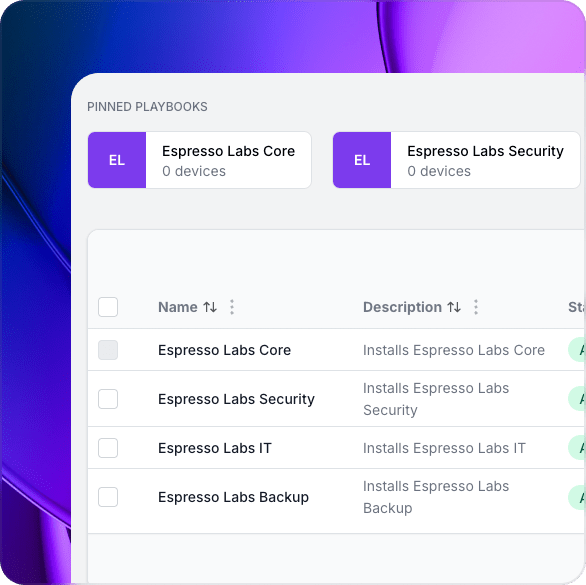
Side-by-Side Comparison
Same category — managing your IT environment. A different amount of it that runs on its own.
| Capability | Ninja / Datto RMM | Espresso Labs |
|---|---|---|
| What it is | RMM console for an IT team or MSP to operate | Autonomous, AI-powered IT, security & compliance service |
| Operation model | ✗ Manual — a person configures policies and works every alert | ✓ Autonomous — AI agent detects, triages, and resolves on its own |
| Who operates it | Requires an in-house IT hire or an MSP behind the console | Fully managed — no internal operator needed |
| Security operations | Patch management plus third-party AV/EDR integrations | Full AI-powered SOC — 24/7 threat monitoring and response built in |
| Alerting vs. resolution | ✗ Generates alerts and tickets for a human to act on | ✓ Resolves autonomously; escalates to a human only when needed |
| Compliance mapping | ✗ Not built around a regulatory framework | ✓ Regulatory controls mapped directly to implementation playbooks |
| Control to implementation | You interpret the requirement and build the fix yourself | Platform translates each control into concrete configuration and enforcement |
| Continuous compliance | Not tracked — requires a separate GRC tool | Enforced and monitored continuously in the same platform |
| Cost model | Per-endpoint license, plus the labor to run it | All-inclusive, predictable monthly fee |
| Best for | MSPs and IT teams who want a console to operate themselves | SMBs who want IT, security, and compliance handled autonomously |
Which One Do You Actually Need?
An RMM Might Be Enough If
- •You have an in-house IT team or MSP dedicated to operating the console
- •You mainly need remote patching, scripting, and device access
- •You don't have a regulatory compliance requirement to manage
- •You already have separate security and GRC tooling in place
Espresso Labs Makes More Sense If
- ✓You want IT and security issues resolved autonomously, not queued as tickets
- ✓You want a full AI-powered SOC watching your environment 24/7
- ✓You need regulatory controls implemented and continuously enforced, not just device management
- ✓You don't want to hire or manage an operator to run the platform
Stop Operating a Console. Start Running on Autopilot.
See what an autonomous, AI-powered IT, security, and compliance platform looks like.
Talk to our team