CMMC Assessment vs. Audit: What the Difference Means for Your OSC
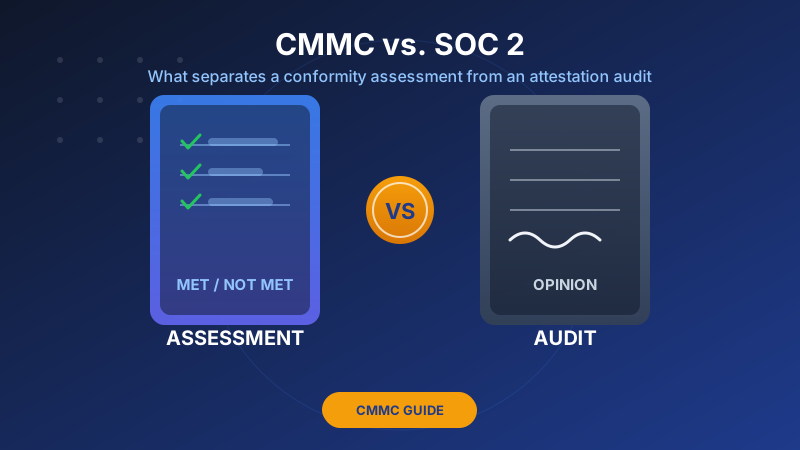
A prospective client asks your compliance lead, “So when’s your CMMC audit scheduled?” It’s a reasonable question. It’s also the wrong word, and the distinction is not pedantic. The CMMC program deliberately does not use the term “audit” anywhere in its official documentation. It uses “assessment.” That word choice reflects a different legal structure, a different type of evidence, and a different set of consequences than the audits most businesses are used to, like a SOC 2 examination.
TL;DR: A CMMC assessment is a conformity check against a fixed list of security requirements, conducted by a certified third-party assessment organization (C3PAO) and reported to the federal government. A SOC 2 audit is an attestation engagement performed by a CPA firm that results in a professional opinion shared with customers. The organization being evaluated under CMMC has a specific legal name, the OSC, or Organization Seeking Certification, and that label carries obligations that go beyond what a typical “audited” company signs up for.
Why CMMC Uses “Assessment,” Not “Audit”
In everyday conversation, people use “audit” as a catch-all for “someone independent checked our security.” That shorthand works fine for a SOC 2 audit or a HIPAA audit, but it breaks down with CMMC because the underlying process is structurally different.
A SOC 2 audit is an attestation engagement. A licensed CPA firm evaluates your controls against the Trust Services Criteria you selected, forms a professional opinion, and issues a report, Type I or Type II, that states whether your controls are suitably designed and (for Type II) operating effectively over a period of time. The auditor’s judgment is part of the deliverable. Two audit firms can reasonably reach different conclusions about the same control environment.
A CMMC assessment is a conformity assessment. The assessor evaluates your environment against a fixed, published list, all 110 security requirements in NIST SP 800-171 Revision 2 for Level 2, using a defined methodology (NIST SP 800-171A) that scores each requirement as MET or NOT MET based on three assessment procedures: examine, interview, and test. There is no professional opinion to render. Either the evidence demonstrates the control is implemented, or it doesn’t. That binary, evidence-driven structure is why the CMMC Assessment Process (CAP) guide and the Cyber-AB never call it an audit.
This is also why the CMMC certification badge you eventually receive is called a Certificate of CMMC Status, not an audit opinion, and why the results get submitted directly to a federal system rather than shared privately with the customers who requested it.
CMMC Assessment vs. SOC 2 Audit: The Concrete Differences
| CMMC Assessment | SOC 2 Audit | |
|---|---|---|
| Who performs it | A C3PAO (Certified Third-Party Assessment Organization) accredited by the Cyber-AB, using assessors holding the Certified CMMC Assessor (CCA) credential | A licensed CPA firm operating under AICPA attestation standards |
| What it’s measured against | A fixed list: all 110 practices in NIST SP 800-171 r2 for Level 2, assessed using NIST SP 800-171A objectives | Trust Services Criteria the company itself selects (security, availability, confidentiality, etc.) |
| Type of output | A pass/fail conformity determination and numeric SPRS score, no professional “opinion” involved | A written opinion letter from the auditor, describing control design and (for Type II) operating effectiveness |
| Who sees the results | Submitted to the DoD via SPRS and CMMC eMASS; the government is the primary audience | Shared privately with customers and prospects under NDA; the market is the primary audience |
| Legal stakes for false claims | Federal False Claims Act exposure for misrepresentation, since results support eligibility for federal contracts | Contractual and reputational exposure; no federal statute directly tied to the attestation itself |
| Renewal cycle | Valid three years, with a signed annual affirmation required in between | Typically repeated annually at the customer’s or market’s expectation, no legally mandated renewal clock |
| Terminology used in official guidance | “Assessment” exclusively | “Audit” and “examination” are both used interchangeably |
The practical upshot: a SOC 2 audit is a market signal. It exists because customers want assurance, and a failed or qualified opinion mostly costs you deals. A CMMC assessment is a regulatory gate. It exists because the DoD requires evidence of compliance as a condition of doing business, and a failed assessment costs you contract eligibility, not just a customer’s confidence.
What “OSC” Actually Means, and Why the Term Carries Weight
Throughout CMMC documentation, the company being assessed is never called “the client” or “the audited entity.” It’s called the OSC, the Organization Seeking Certification. That’s not just formal styling. The label marks a specific legal relationship that doesn’t exist in a typical SOC 2 engagement.
Here’s what OSC status actually obligates you to do:
- You own the System Security Plan (SSP) before the assessment starts. The C3PAO doesn’t build your documentation. As the OSC, you arrive with an SSP that already describes how every one of the 110 controls is implemented in your specific environment. An incomplete or inconsistent SSP is one of the most common reasons assessments stall.
- A senior company official signs annual affirmations, personally. Every year between your three-year certification cycles, someone in your organization affirms, in writing and under penalty of law, that you still meet the requirements. This is not a compliance team checkbox. It’s a personal legal attestation, and it is the mechanism that creates False Claims Act exposure if it turns out to be false.
- You manage your own POA&M closeout clock. If you pass with a Plan of Action and Milestones for minor gaps, the OSC is responsible for closing those items within the allowed window, generally 180 days, without prompting from the assessor.
- You cannot use the same firm to prepare you and certify you. RPOs (Registered Provider Organizations) can advise you. C3PAOs certify you. As the OSC, it’s your responsibility to keep those two vendor relationships separate; the Cyber-AB treats this as a conflict-of-interest violation if blurred.
- Your status is continuously reportable, not point-in-time. Being an “OSC” doesn’t end when the assessor leaves. The designation follows your organization through the full three-year cycle, including the obligation to disclose material changes to your environment that could affect your certified status.
Compare that to a company undergoing a SOC 2 audit. Management provides a written assertion to the auditor, but there’s no federal statute attaching personal liability to that assertion, no government system tracking your status, and no requirement to re-affirm annually under penalty of law. Being an OSC is a heavier, more legally exposed position than being “the company getting audited,” and treating the two as equivalent is exactly the assumption that gets contractors in trouble.
Sources and further reading
- CMMC Program: official DoD CIO page
- 32 CFR Part 170: Cybersecurity Maturity Model Certification (CMMC) Program (eCFR)
- NIST SP 800-171 Rev. 2: Protecting Controlled Unclassified Information in Nonfederal Systems and Organizations
- The Cyber AB: CMMC Accreditation Body
Frequently Asked Questions About CMMC Assessments
How This Applies to Espresso Labs
Espresso Labs works with defense contractors who are, in the language of the program, OSCs, either heading toward their first CMMC assessment or maintaining certification through the annual affirmation cycle. The distinction between “assessment” and “audit” isn’t academic for these clients; it shapes exactly what Espresso Labs is built to deliver.
Because a CMMC assessment scores discrete, evidenced requirements rather than accepting a professional judgment call, Espresso Labs focuses on the thing that actually gets scored: continuously operating controls with automatically collected evidence, mapped directly to the 110 NIST SP 800-171 practices your C3PAO will test. That means when your organization walks into a Level 2 assessment as the OSC, your SSP already reflects reality, your access control logs and configuration evidence are current rather than reconstructed the week before, and your team can speak fluently to how each control operates day to day.
The OSC obligations that persist after certification, the annual affirmation, the POA&M closeout clock, the requirement to disclose material environment changes, don’t stop mattering once the assessor leaves. Espresso Labs’ 24/7 monitoring and automated remediation exist precisely so that the posture your C3PAO certified on day one is the same posture your senior official is affirming, truthfully, a year later. For organizations that also carry a SOC 2 report alongside CMMC certification, Espresso Labs runs both control sets from the same underlying evidence base, so the SOC 2 audit season and the CMMC affirmation cycle don’t turn into two separate scrambles.
The goal is straightforward: by the time a C3PAO or an auditor shows up, there’s nothing to prepare, because the evidence was already being collected the whole time.