CMMC Compliance Checklist for 2026: A Practical Guide for Defense Contractors
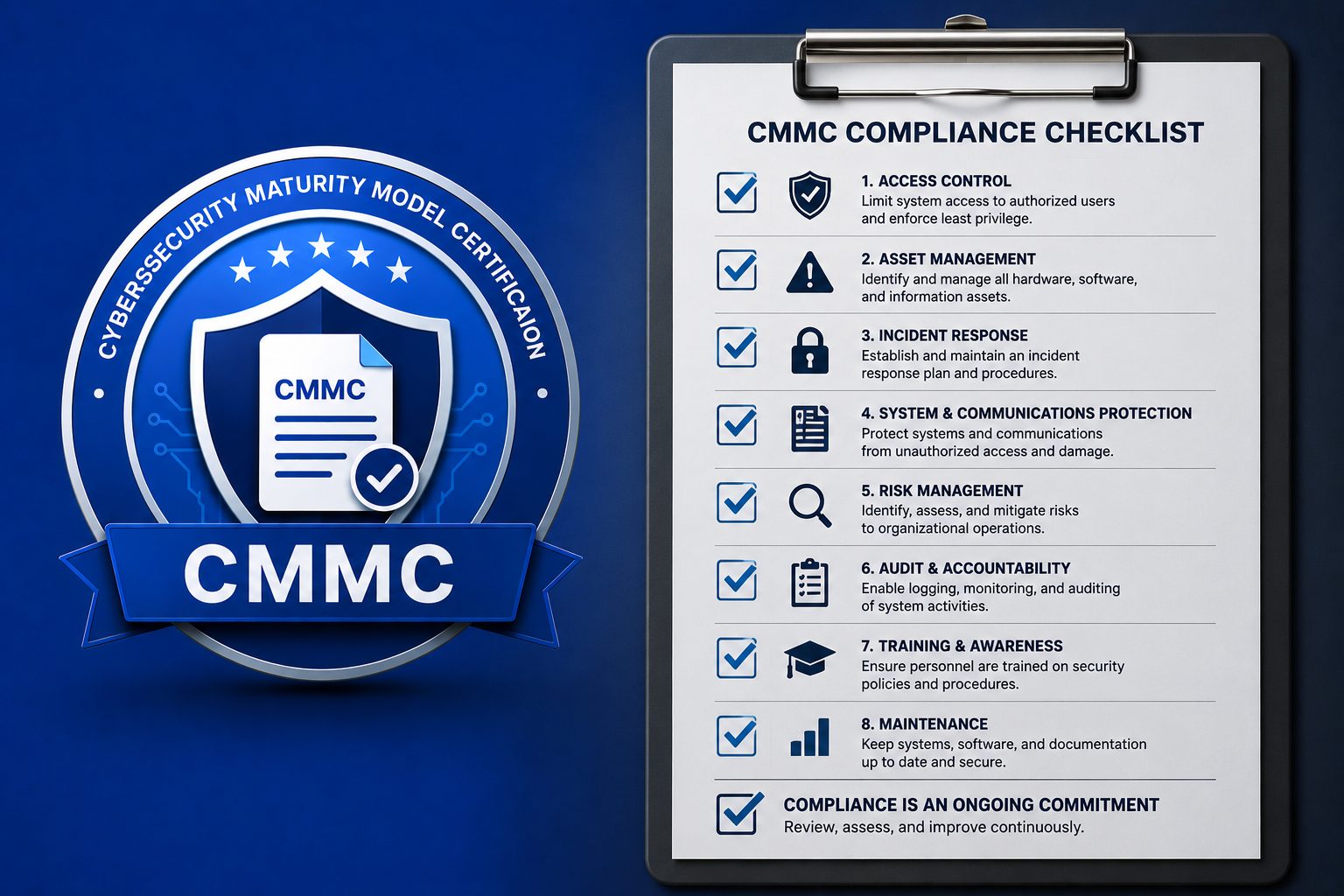
CMMC is no longer a future requirement. It is becoming a prerequisite for maintaining and winning DoD contracts. Organizations that handle Controlled Unclassified Information (CUI) must demonstrate compliance with NIST SP 800-171 and, in most cases, successfully complete a third-party assessment. The challenge is that achieving compliance involves much more than deploying a few security tools. It requires technology, documentation, operational processes, evidence collection, and continuous maintenance.
This checklist provides a practical roadmap for organizations pursuing CMMC Level 2 certification. For a broader look at the templates, tools, and vendors available at each stage, see our CMMC resources guide.
Step 1: Determine Whether CMMC Applies to Your Organization
Before investing in compliance, determine:
- Whether you handle Federal Contract Information (FCI) or CUI (Controlled Unclassified Information)
- Which CMMC level applies to your contracts
- Whether CMMC requirements are being flowed down from a prime contractor
- Which DFARS clauses apply to your business
- Whether your contracts require self-assessment or third-party certification
The CMMC level your organization must achieve will depend on the type of information you handle and the requirements specified in your contracts:
- CMMC Level 1 applies to organizations that handle only FCI and focuses on basic cyber hygiene practices.
- CMMC Level 2 applies to organizations that store, process, or transmit CUI and requires implementation of the 110 security requirements defined in NIST SP 800-171.
- CMMC Level 3 is intended for select organizations supporting higher-priority DoD programs and includes additional requirements beyond NIST 800-171.
Many organizations discover they are subject to CMMC requirements through subcontracting relationships rather than direct DoD contracts.
Step 2: Define Your Compliance Scope
One of the biggest drivers of cost is scope.
Document:
- Systems that store, process, or transmit CUI
- Employees who access CUI
- Third-party providers
- Cloud services
- Devices and endpoints
Reducing the number of systems and users that touch CUI can dramatically reduce compliance complexity and assessment costs. Many organizations use enclaves or isolated environments to limit scope.
Step 3: Perform a NIST 800-171 Gap Assessment
CMMC Level 2 is built around the 110 requirements of NIST SP 800-171.
Review your current environment against:
- Access Control
- Audit & Accountability
- Configuration Management
- Incident Response
- Risk Assessment
- Security Awareness Training
- System & Information Integrity
Identify gaps and prioritize remediation efforts based on risk and implementation effort.
Step 4: Create Core Compliance Documentation
Technology alone is not enough.
Develop and maintain:
- System Security Plan (SSP)
- Policies and procedures
- Incident Response Plan
- Risk Assessment documentation
- Access control procedures
- Configuration management processes
- Plan of Action & Milestones (POA&M)
Assessors will expect documentation to align with how controls are implemented in practice.
Step 5: Protect Controlled Unclassified Information (CUI)
Determine how CUI is:
- Stored
- Shared
- Accessed
- Transmitted
Organizations should ensure:
- Encryption is used where required
- Access is restricted to authorized users
- Sharing is controlled and auditable
- External collaboration follows security requirements
Limiting where CUI resides is often one of the fastest ways to simplify compliance.
Step 6: Implement Security Controls
Deploy the technical and administrative controls needed to satisfy NIST 800-171 requirements.
Examples include:
- Multi-factor authentication (MFA)
- Endpoint protection and EDR
- Vulnerability management
- Secure configuration baselines
- Log collection and monitoring
- Backup and recovery controls
- Device management
- Encryption
The objective is not merely deploying tools but ensuring controls are consistently enforced and monitored.
Step 7: Establish Security Awareness Training
Train personnel on:
- Phishing attacks
- Password management
- Handling CUI
- Incident reporting
- Social engineering
Security awareness training should be ongoing rather than a one-time exercise and supported by documentation and evidence.
Step 8: Build an Incident Response Program
Organizations should be able to:
- Detect incidents
- Escalate incidents
- Investigate incidents
- Contain threats
- Recover operations
Conduct tabletop exercises periodically to validate response procedures and demonstrate operational readiness.
Step 9: Implement Continuous Monitoring
Compliance is not a one-time project.
Continuously monitor:
- Endpoints
- User activity
- Security events
- Vulnerabilities
- Configuration changes
- Access permissions
Many organizations fail assessments because controls exist but are not consistently maintained. Continuous monitoring helps close that gap.
Step 10: Evidence Collection
Assessors do not simply verify controls exist—they require evidence.
Collect evidence for:
- MFA enforcement
- User access reviews
- Security awareness training
- Vulnerability remediation
- Patch management
- Incident response activities
- Audit logs
Automated evidence collection can significantly reduce audit preparation effort and improve assessment outcomes. Evidence management is increasingly viewed as one of the most important aspects of successful CMMC programs.
Step 11: Conduct an Internal Readiness Assessment
Before engaging a C3PAO:
- Review all 110 NIST 800-171 requirements
- Validate documentation
- Confirm evidence availability
- Test incident response processes
- Verify technical control operation
Treat this as a mock assessment rather than a paperwork review.
Step 12: Conduct an Internal Readiness Assessment
Final preparation should include:
- Final SSP review
- Evidence validation
- Personnel interviews
- Scope confirmation
- POA&M review
Organizations that enter assessments with organized evidence and well-defined processes typically experience smoother assessments and fewer delays
Common Mistakes That Delay Certification
- Waiting for contract requirements before starting
- Underestimating documentation requirements
- Treating compliance as a one-time project
- Failing to limit scope
- Collecting evidence manually
- Assuming technology alone creates compliance
How AI and Automation Accelerate Compliance
Traditional compliance programs often require multiple tools, consultants, and internal staff.
Modern compliance platforms can automate:
- Control monitoring
- Evidence collection
- Vulnerability management
- Security operations
- Documentation management
This approach reduces cost, shortens timelines, and helps organizations maintain compliance long after certification is achieved.
Final Checklist
- Determine CMMC level
- Define scope and CUI boundary
- Perform NIST 800-171 gap assessment
- Create SSP and policies
- Protect CUI
- Deploy required controls
- Train users
- Build incident response capabilities
- Establish continuous monitoring
- Automate evidence collection
- Conduct readiness assessment
- Complete C3PAO assessment
Organizations that start early and focus on continuous compliance are far more likely to achieve certification efficiently and maintain it successfully over time.