CMMC Resources: Guides, Checklists & Compliance Tools for Defense Contractors
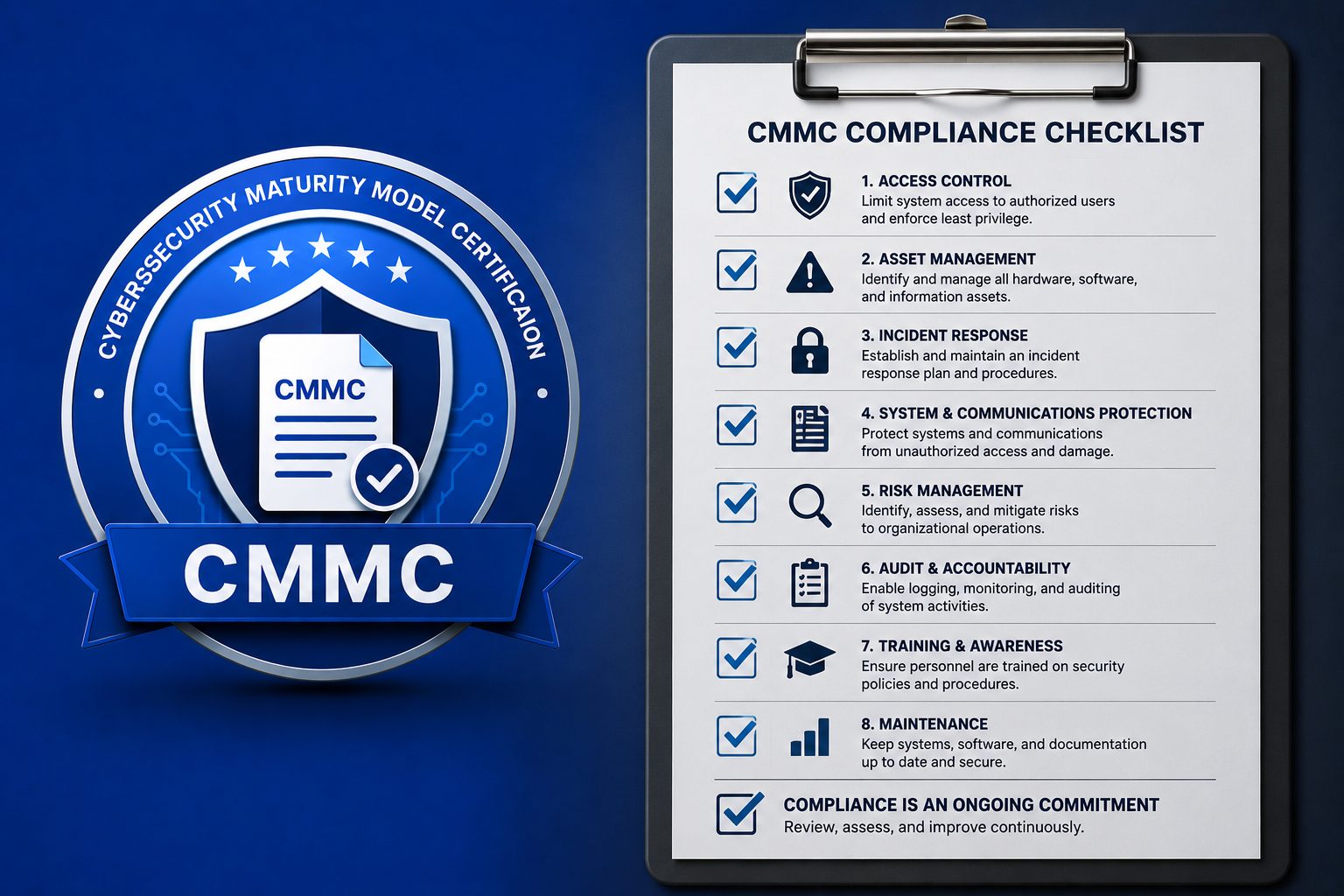
If your company holds DoD contracts or pursues them, CMMC compliance is no longer a future problem. Phase 1 enforcement went live in November 2025. Phase 2 expands requirements to a much broader set of contracts starting November 10, 2026. Most organizations dramatically underestimate the scope: what looks like a checklist exercise turns into months of documentation, technical controls, and audit prep that can stall operations and threaten contract eligibility. The good news is that the right resources, guides, checklists, and tools, can cut through the complexity. This guide maps out exactly what you need and how to use it.
What CMMC Actually Requires (And Why the Timeline Is Urgent)
Picture a 200-person manufacturer that lands a DoD subcontract, assumes their existing IT setup is “probably fine,” and plans to sort out compliance “before the next renewal.” Then Phase 1 hits, the prime contractor asks for their CMMC status, and the answer is: nowhere close. That scenario is playing out across the Defense Industrial Base right now.
Here is the landscape. The CMMC Final Rule became effective December 16, 2024, with phased enforcement running through FY2028. Phase 1 is already live: select contracts now require Level 1 or Level 2 self-assessments, and some require a formal Level 2 Certification Assessment conducted by a Certified Third-Party Assessor Organization (C3PAO). Phase 2 begins November 10, 2026, expanding coverage to a much broader contract set and introducing Level 3 assessments.
The three levels break down like this:
- Level 1: 15 basic cybersecurity practices, annual self-assessment, applies to contractors handling Federal Contract Information (FCI)
- Level 2: 110 NIST SP 800-171 controls, C3PAO assessment required for most contractors, applies to Controlled Unclassified Information (CUI)
- Level 3: 24 additional controls from NIST SP 800-172, applies to roughly 1% of the Defense Industrial Base
More than 300,000 prime contractors, subcontractors, universities, and researchers are affected. And the penalty for non-compliance is not a fine. It is disqualification from contract eligibility. You do not get a warning letter. You lose the work.
One critical trap: many organizations assume Level 1 self-assessment is sufficient, only to discover mid-process that their specific contracts require Level 2 C3PAO certification. Read your contract language carefully before you assume anything.
Once you know which level applies, the next question is what the compliance process actually looks like in practice, and where most organizations get stuck.
The CMMC Compliance Roadmap: Key Documents and Controls
A mid-sized manufacturer once described their CMMC preparation as “death by documentation.” They had solid security tools already deployed. What they lacked was the paper trail to prove it: no SSP, no POA&M, no evidence mapped to specific controls. Their C3PAO assessment got delayed by four months while they scrambled to build documentation retroactively. That delay nearly cost them a contract renewal.
Compliance starts with a gap analysis benchmarked against NIST SP 800-171. This tells you where you stand before you spend a dollar on remediation. From there, you build two foundational documents and deploy the technical controls that make everything provable.
Two scoping decisions shape your entire approach. Enterprise-wide scoping applies controls across all IT systems. Enclave-based scoping isolates CUI in a dedicated environment separated from the broader network. Enclave scoping is gaining traction as a cost-reduction strategy, but it requires careful architecture planning or you risk creating a compliance boundary that does not hold up under assessment scrutiny.
The technical controls that must be deployed include MFA for remote and privileged access, a SIEM for log aggregation, and advanced endpoint detection and response (EDR). These are not optional enhancements. They are baseline requirements. One mid-sized manufacturer lost Level 2 renewal specifically because of patch management gaps on endpoints, controls that were in the SSP but not actually enforced in production.
Subcontractor risk is a dimension many prime contractors overlook. If a subcontractor handling CUI fails to maintain compliance, that risk flows back to you. You are responsible for the security posture of your supply chain, not just your own environment.
The SSP and POA&M: Your Two Non-Negotiable Artifacts
The System Security Plan is the most critical document in your CMMC package. It must explicitly address all 110 Level 2 practices, describe your CUI environment in detail, and identify who is responsible for each control. Think of it as a living contract between your organization and the assessor.
The Plan of Action and Milestones documents any controls not yet fully implemented, along with the timeline and owner for closing each gap. Assessors expect to see a POA&M. A missing one does not signal a clean environment. It signals unmanaged risk.
Both documents must be maintained continuously. Organizations that treat them as one-time deliverables, built for the assessment and then shelved, fail re-assessments because the documents no longer reflect reality. Real-time documentation is not bureaucratic overhead. It is your audit defense.
Knowing what is required is one thing. Having the right tools and templates to actually build it is another. Here is what to look for in a CMMC resource stack.
CMMC Tools and Checklists: What to Use and What to Watch Out For
A checklist is useful the way a map is useful: it shows you where you need to go, but it does not drive you there. That distinction matters enormously when you are looking at 110 controls, continuous monitoring requirements, and an assessment that can happen at any time.
The core resource types you need:
- Gap analysis tools to benchmark your current posture against NIST SP 800-171
- SSP templates to structure your documentation (the most-searched resource for a reason)
- POA&M trackers to manage remediation timelines and ownership
- GRC and compliance automation platforms to centralize evidence collection and control verification
- SIEM and EDR solutions to provide the continuous monitoring that assessors will look for
Automation is now the standard, not the exception. Manual processes simply do not scale to 110 controls across a live environment. SIEM systems and GRC platforms streamline evidence collection, logging, and reporting. The organizations that try to manage this in spreadsheets are the ones racing to compile documentation the night before an assessment, which is one of the most common and costly mistakes in CMMC preparation.
Here is an honest look at the main options in the market:
Managed Service Providers (MSPs) are often the first call organizations make, especially if an MSP already manages their day-to-day IT. A good MSP can handle patching, backups, endpoint management, and general help desk support, and some will bolt on basic security monitoring. The limitation is that most MSPs were built for IT operations, not compliance frameworks. Their processes tend to be ticket-driven and manual rather than automated: someone opens a ticket, someone else resolves it, and evidence gets assembled by hand when an assessment is coming up. That model works for keeping the lights on, but it does not scale well to 110 continuously enforced controls and the ongoing evidence trail a C3PAO assessment demands.
Vanta, Drata, Secureframe, and others offer GRC platforms with CMMC implementation checklists, scoping guidance, and control mapping frameworks. More structured than a static checklist. The consistent limitation across these tools: they still require internal compliance expertise to configure and maintain properly. They identify gaps but do not close them. You still need technical implementation, continuous monitoring, and evidence management on your side. Before you sign with any of them, run the vendor through our buyer’s guide to CMMC compliance software, which walks through the capabilities and red flags that separate a tool that documents compliance from one that helps you achieve it.
Espresso Labs functions as your virtual IT, cybersecurity, and compliance team: mapping CMMC policies to automated playbooks, enforcing controls continuously, remediating issues in real time, and collecting audit-ready evidence as a byproduct of daily operations. Rather than handing you a checklist and leaving you to staff and implement 110 controls on your own, it handles the operational execution.
For official government resources, start with the DoD CIO’s CMMC program page for assessment procedures and program requirements, and NIST SP 800-171 for the underlying 110 controls every Level 2 SSP must map to. The DFARS cybersecurity clauses on Acquisition.gov spell out exactly which contract language triggers these requirements, and the Pentagon’s Defense Pricing and Contracting office oversees how those clauses get applied across DoD contracts.
The honest trade-off with standalone tools: a checklist that surfaces 40 control gaps is valuable. A system that closes those gaps and documents the closure automatically is what actually gets you through an assessment.
Understanding the tools is useful. But the harder question for most organizations is whether to build compliance capability internally or get outside help, especially given the cost and complexity involved.
How Espresso Labs Makes CMMC Compliance Manageable
Every resource in this guide, the checklists, SSP templates, GRC platforms, and advisory hubs, tells you what needs to happen. Espresso Labs makes it happen.
Rather than handing you a list of 110 controls and leaving you to staff, implement, and maintain them with whatever internal resources you have, Espresso Labs acts as your virtual IT, cybersecurity, and compliance team. CMMC policies get mapped to automated playbooks that enforce controls continuously. Issues get remediated in real time, not discovered during a quarterly review. Audit-ready evidence gets collected as a byproduct of daily operations, not assembled in a panic before an assessment.
The practical difference: continuous monitoring and automated remediation instead of point-in-time snapshots. Evidence collection built into operations, not bolted on. Coverage across IT operations, device management, 24/7 security monitoring, and threat response. And for organizations managing multiple frameworks, Espresso Labs supports CMMC alongside SOC 2 and ISO 27001, so you are not running parallel compliance programs with separate tooling.
This matters especially for organizations without large internal IT or compliance teams. Building the internal capability to maintain 110 controls, continuously monitor systems, collect evidence, and manage a C3PAO assessment is a significant investment in headcount and tooling. Espresso Labs delivers that capability without requiring you to build it from scratch.
With Phase 2 expanding requirements in November 2026, the organizations that start now with a managed, automated approach will be the ones that pass assessments and keep their contracts. The ones that wait for requirements to appear in a solicitation will be the ones scrambling. If you are reading this guide and thinking “we need to get moving,” that instinct is correct. Espresso Labs is the logical next step.