CMMC vs. NIST 800-171: Is CMMC 2.0 Replacing NIST 800-171?
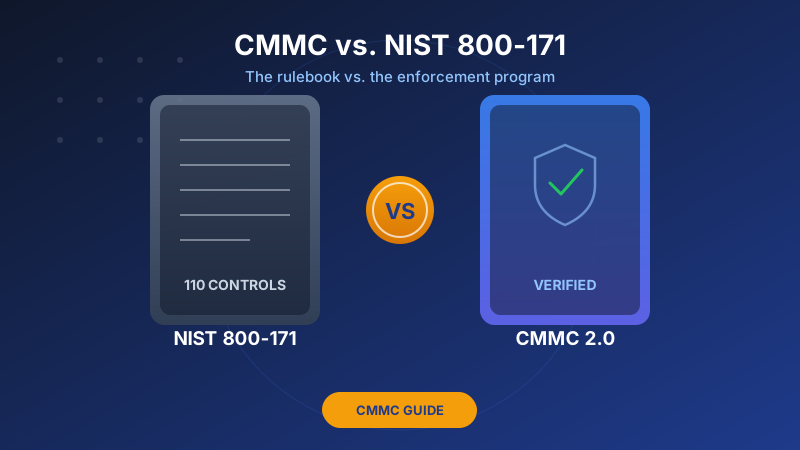
The Short Answer: CMMC 2.0 is not replacing NIST 800-171. Think of it this way: NIST 800-171 is the rulebook that defines exactly how you must protect Controlled Unclassified Information. CMMC is the enforcement program that verifies you are actually following that rulebook. One sets the standard, the other proves you meet it. Both are active obligations right now, and the current DoD pause on Phase 2 enforcement does not change that. If you handle CUI and are waiting for clarity before acting, you are already behind.
If you work with the Department of Defense, you have probably heard “CMMC” and “NIST 800-171” used as if they mean the same thing. They don’t, and that confusion is quietly putting contracts at risk. The DoD’s recent pause on CMMC Phase 2 enforcement has made things murkier: some contractors are treating it as permission to stop preparing, which is exactly the wrong call. Meanwhile, a proposed FAR rule is expanding NIST 800-171 obligations far beyond the defense industrial base, meaning the compliance window is shrinking whether CMMC moves forward or not. In short: CMMC 2.0 is built on top of NIST 800-171, not instead of it, and both frameworks demand action now.
NIST 800-171 and CMMC 2.0 Are Not the Same Thing: Here’s What Each Actually Requires
Picture two contractors bidding on the same DoD contract. Both claim they’re “NIST compliant.” One has done a self-assessment, submitted a score to the Supplier Performance Risk System (SPRS), and called it a day. The other has gone through a rigorous third-party assessment by an accredited C3PAO. Only one of them will be able to bid on contracts requiring CMMC certification. The other may not even realize they’re exposed.
NIST 800-171 is a NIST-published technical standard, currently on Revision 3, covering 110 security requirements across 17 control families. Its job is to define what you need to protect Controlled Unclassified Information (CUI). It is the underlying technical baseline. The rulebook.
CMMC 2.0 is a DoD certification program that uses NIST 800-171 as its technical foundation. CMMC is essentially the enforcement program for NIST 800-171: it takes those 110 requirements and adds independent verification that you actually implemented them, not just that you said you did. CMMC Level 2 (the level most defense contractors will face) maps directly to those same 110 practices. Level 1 covers 15 basic safeguarding practices. Level 3 goes further, pulling in requirements from NIST SP 800-172.
Three differences matter most:
Verification Method
Under DFARS 252.204-7012, NIST 800-171 currently allows contractor self-assessment with a score submitted to SPRS. CMMC Level 2 requires a formal assessment by an accredited C3PAO for most contracts. Self-attestation and third-party certification are not the same thing, legally or practically.
Enforcement Mechanism
NIST 800-171 compliance is a contractual obligation embedded in DFARS clauses today. CMMC is a go/no-go certification requirement that appears in contract solicitations. Fail CMMC, and you cannot bid. Misrepresent your NIST 800-171 score, and you face False Claims Act liability.
Scope
NIST 800-171 applies to any contractor handling CUI under a DFARS clause right now. CMMC applies specifically to DoD contracts and is being phased in by contract type and value.
The most dangerous misconception in the defense contracting world: a passing NIST 800-171 self-assessment does not equal CMMC certification. Not even close.
Now that the distinction is clear, the natural question becomes: if CMMC is built on NIST 800-171, why is there so much confusion about timing, and what does the current DoD pause actually mean for your business?
The CMMC Pause Is Real, But It Is Not a Reason to Stop Preparing
Here is a pattern that plays out every time there is a CMMC delay. Contractors exhale, put their readiness projects on hold, and redirect budget elsewhere. Then enforcement accelerates faster than expected, the C3PAO queue is already months long, and those same contractors are scrambling to pass assessments they are nowhere near ready for. We have seen this cycle before, and the current pause is setting up the same trap.
CMMC Phase 1 (covering Level 1 and certain Level 2 self-assessments) began rolling into contracts in late 2025 under the final CMMC rule, 32 CFR Part 170, which became effective in December 2024. As of mid-2026, DoD has signaled a slowdown on broader Phase 2 enforcement, specifically the requirement for third-party C3PAO assessments to appear in contracts. The reasons cited include C3PAO capacity constraints, cost concerns from the defense industrial base, and ongoing regulatory review.
What the pause does NOT change is significant.
DFARS 252.204-7012 remains fully active. Any contractor handling CUI is still legally required to have NIST 800-171 controls implemented and an accurate SPRS score on file today. A falsified or inflated SPRS score is not just a compliance gap. It is False Claims Act exposure. The Department of Justice has already pursued cases on exactly this basis.
CMMC requirements are also still appearing in active solicitations for Phase 1 scope. The pause affects the pace of Phase 2 expansion, not the existence of the program itself.
There is also a supply-side problem that most contractors underestimate. The number of accredited C3PAOs relative to the volume of contractors who will eventually need assessments remains tight. Wait times for assessments are already stretching several months. Contractors who start their readiness work now will have their pick of assessors and a realistic runway to close gaps. Those who wait will be competing for scarce slots under deadline pressure.
Organizations that have begun formal readiness assessments frequently discover significant SPRS score gaps. In several cases, organizations had submitted scores in the 80s and 90s that, under independent review, were closer to 40 or 50. The gap between self-reported scores and independently assessed scores is not a small rounding error. It is a systemic problem driven by optimistic self-interpretation of controls that were never fully implemented.
The pause only affects one layer of the compliance picture. What most contractors have not yet absorbed is that a separate regulatory track, FAR-based CUI rules, is set to extend NIST 800-171 obligations across virtually all federal contractors, making the framework unavoidable regardless of where CMMC lands.
NIST 800-171 Is Expanding Beyond DoD: The FAR CUI Rule Changes Everything
Imagine building a compliance program specifically for your DoD contracts, treating it as a narrow, defense-specific obligation. Then a rule drops that requires the same framework for your contracts with NASA, DHS, DOE, and every other civilian agency that touches CUI. That is not a hypothetical. It is the trajectory of FAR Case 2021-017.
The proposed FAR CUI rule would require all federal contractors handling CUI, not just DoD suppliers, to comply with NIST 800-171. If finalized, it extends the obligation across the entire federal contracting ecosystem. Organizations that viewed NIST 800-171 as a defense-sector problem will find themselves inside the compliance perimeter whether they planned for it or not.
DFARS 252.204-7012 already requires NIST 800-171 compliance and cyber incident reporting for DoD contractors handling CUI. That is current law. The FAR CUI rule, if finalized, makes NIST 800-171 the de facto baseline for a dramatically wider population of organizations.
There is also a revision to account for. NIST 800-171 Rev 3, released in May 2024, introduced organizational changes and added practices beyond what Rev 2 required. Contractors who assessed against Rev 2 need to re-evaluate their gaps. The goalposts have moved, and many organizations have not updated their assessments to reflect it.
Here is the strategic upside that often gets missed: organizations that build NIST 800-171 compliance infrastructure now are simultaneously building the foundation for CMMC certification and positioning themselves for FAR CUI requirements. One investment. Multiple frameworks covered. Contractors who get there first can also use demonstrated compliance as a differentiator in proposals, particularly when competing against organizations that are still catching up.
The compliance window is real and it is narrowing. Understanding what is required is one thing. Actually achieving and maintaining it across IT systems, policies, and evidence collection is another, especially without a dedicated compliance team. That is where the right partner changes the equation entirely.
Common Questions About CMMC and NIST 800-171
Why Espresso Labs Is the Fastest Path to NIST 800-171 Compliance and CMMC Readiness
This is not a problem you can solve with a spreadsheet and a part-time IT person. NIST 800-171 has 110 controls spanning access control, incident response, system monitoring, configuration management, and more. Each requires documented implementation and audit-ready evidence. CMMC raises the stakes further by requiring that evidence to hold up under a C3PAO’s independent scrutiny.
Most organizations face the same core problem: compliance is treated as a point-in-time exercise. Controls get implemented, a score gets submitted, and then configuration drift, staff changes, and unmonitored systems quietly erode the posture that score was based on. By the time a C3PAO shows up, the gap between what was certified and what actually exists can be substantial.
Espresso Labs is built to solve exactly that problem. As a fully managed, AI-powered virtual IT, cybersecurity, and compliance team, Espresso Labs covers the full stack: day-to-day IT operations, device management, 24/7 security monitoring, and threat response. Every one of those functions maps directly to NIST 800-171 control families. You are not buying a compliance tool on top of your existing infrastructure. You are getting the infrastructure and the compliance coverage together.
The capability that matters most for CMMC readiness is continuous enforcement. Espresso Labs maps organizational policies to automated playbooks that enforce controls in real time, eliminating the drift that causes contractors to fail assessments months after self-certifying. Audit-ready evidence is collected automatically, which is critical for SPRS score accuracy today and C3PAO assessment readiness when Phase 2 enforcement accelerates.
One engagement with Espresso Labs covers NIST 800-171, CMMC Level 2, and positions your organization for the FAR CUI rule. That is three compliance obligations addressed through a single, continuously managed program, at a fraction of the cost of hiring a CISO, compliance officer, and expanded IT team.
The first step is knowing where you actually stand. A compliance gap assessment tells you what your real SPRS score looks like before a C3PAO or a contracting officer finds out for you. If you are handling CUI and have not had that conversation yet, the time to start is now, not when the next solicitation lands on your desk with a CMMC requirement you are not ready for.