How Much Does CMMC Certification Cost?
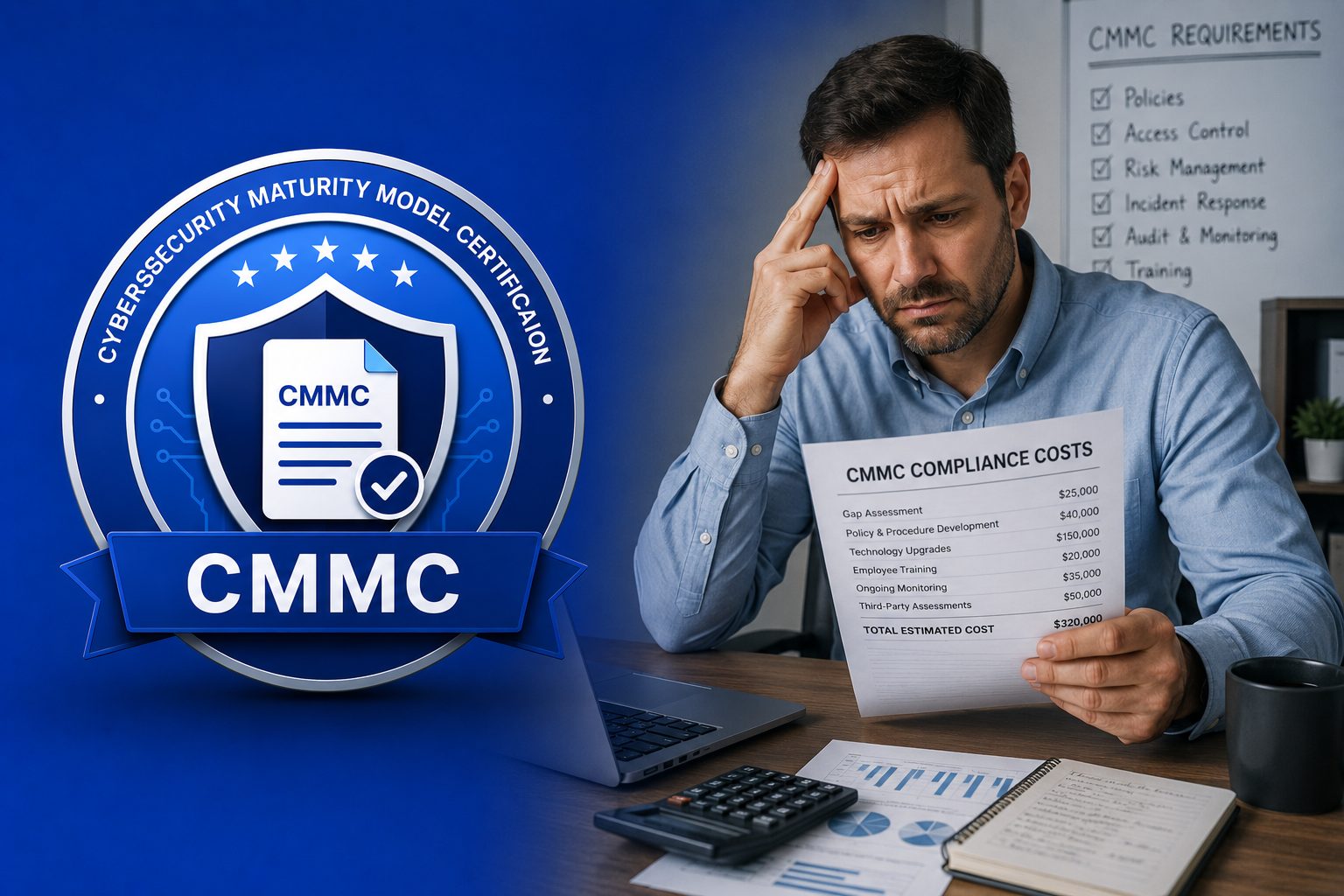
The cost of achieving and maintaining CMMC certification varies based on factors such as organization size, number of users and devices, existing security maturity, the amount of CUI in scope, and the approach used to implement compliance. For many small and mid-sized defense contractors, traditional CMMC programs involving multiple security tools, consultants, internal resources, and ongoing management can cost $450,000 to $750,000 or more over a three-year period.
For many organizations in the Defense Industrial Base (DIB), CMMC compliance is no longer optional. It is becoming a requirement for maintaining existing DoD business and qualifying for future contracts.
CMMC (Cybersecurity Maturity Model Certification) was created to combat escalating cyber threats targeting defense contractors and the Defense Industrial Base. However, achieving and maintaining compliance has traditionally required significant investments in technology, expertise, and operational resources.
While achieving CMMC compliance requires an investment of time and resources, the consequences of non-compliance can be far more costly. Contractors that fail to certify may lose access to existing and future DoD business, face greater exposure from CUI-related incidents, and find themselves at a competitive disadvantage. For most organizations in the Defense Industrial Base, CMMC is not simply a compliance requirement, it is a business imperative that protects both revenue and long-term growth.
Key Compliance Costs (Level 2)
| Phase | Typical Cost Range |
|---|---|
| Preparation / Gap Analysis | $40,000 – $100,000 |
| Policy Development | $10,000 – $50,000 |
| Technical Implementation | $150,000 – $500,000 |
| C3PAO Assessment | $30,000 – $100,000 |
| Continuous Compliance (annual) | $50,000 – $100,000+ |
| 3-Year Total | $450,000 – $750,000+ |
1. Preparation / Gap Analysis: $40K-100K
A CMMC gap assessment is one of the most important steps in the certification process. Its purpose is to evaluate your organization’s current cybersecurity posture against the requirements of NIST SP 800-171 and identify the technical, operational, and documentation gaps that must be addressed before a C3PAO assessment. Beyond reviewing security controls, a thorough assessment also validates that controls are properly implemented, consistently enforced, and supported by sufficient evidence and documentation.
This phase typically includes:
| Activity | Description |
|---|---|
| CUI Scoping and Boundary Definition | Identify where CUI is stored, processed, and transmitted, map data flows, and determine which systems, users, and third parties fall within the assessment boundary. Proper CUI scoping is often the single biggest factor in controlling CMMC costs and complexity. |
| NIST 800-171 Gap Assessment | Evaluate existing security controls against the 110 NIST 800-171 requirements and identify deficiencies that could prevent certification. Assessments should be performed by professionals with specific CMMC expertise. |
| Policy and Documentation Review | Review existing policies, procedures, SSPs, and related documentation to identify missing or incomplete compliance artifacts. Many organizations discover they have implemented controls but lack the documentation to demonstrate compliance. |
| Vulnerability and Security Assessment | Perform vulnerability scanning and security reviews to identify weaknesses requiring remediation before certification, including endpoint, network, cloud, and configuration assessments. |
| Compliance Roadmap and Remediation Planning | Develop a prioritized implementation plan outlining remediation activities, resource requirements, timelines, technology needs, and organizational changes necessary to achieve certification. |
The duration and cost of this phase depend largely on the size of the organization, the complexity of the IT environment, and the amount of CUI in scope. Organizations that invest in proper planning and gap analysis early typically achieve certification faster and at a significantly lower overall cost than those that defer these activities until shortly before their assessment.
2. Documentation & Policy Development: $10,000-$50,000
Documentation is a critical component of achieving CMMC certification and demonstrating compliance with NIST SP 800-171. During a CMMC assessment, organizations must not only show that security controls are in place, but also provide clear evidence that those controls are documented, implemented, and consistently followed. For many defense contractors, documentation becomes one of the most time-consuming aspects of the certification process.
A successful CMMC compliance program requires comprehensive documentation that accurately reflects the organization’s security environment, CUI handling procedures, operational processes, and control implementation. Incomplete or outdated documentation is one of the most common reasons organizations struggle during C3PAO assessments.
Key documentation requirements typically include:
| Document | Description |
|---|---|
| System Security Plan (SSP) | Foundation of your CMMC compliance program. Documents your CUI environment, assessment scope, security architecture, and implementation of all 110 NIST 800-171 requirements. Often the first document assessors review. |
| Security Policies and Procedures | Policies covering access control, incident response, risk management, configuration management, media protection, and security awareness training — aligned to actual business practices. |
| Standard Operating Procedures (SOPs) | Detailed instructions for executing security and compliance processes, including user onboarding, vulnerability remediation, access reviews, incident response, and evidence collection. |
| Plan of Action & Milestones (POA&M) | Tracks identified security gaps, remediation activities, responsible personnel, and target completion dates. A key management tool throughout the CMMC readiness process. |
| Network Diagrams and CUI Data Flow Documentation | Current network diagrams, system inventories, and CUI data flow maps that clearly identify where CUI is stored, processed, and transmitted. Reduces assessment complexity and demonstrates a well-defined compliance boundary. |
Organizations with mature documentation practices typically achieve CMMC certification more efficiently and at lower cost. Conversely, organizations starting from scratch often underestimate the effort required to develop compliant documentation. Many defense contractors leverage specialized CMMC consultants or automated compliance platforms to accelerate documentation development, improve consistency, and simplify ongoing maintenance.
3. Technical Implementation: $150,000-$500,000
Achieving CMMC Level 2 compliance and implementing the 110 NIST SP 800-171 security requirements often requires organizations to deploy and manage a broad range of cybersecurity, compliance, and IT management technologies. While specific requirements vary based on organizational size, assessment scope, and CUI handling practices, most defense contractors must implement controls across endpoint security, identity management, data protection, monitoring, and compliance operations.
Common technology categories include:
| Technology Category | What It Covers |
|---|---|
| Endpoint Security and EDR | Protect workstations, laptops, and servers from malware and advanced threats while providing detection, investigation, and response capabilities. |
| Asset and Device Management | Maintain an accurate inventory of hardware, software, cloud assets, and authorized devices — foundational to demonstrating control over systems in scope. |
| Identity and Access Management (IAM) | MFA, privileged access management, user provisioning, access reviews, password policies, and role-based access controls. |
| Patch and Vulnerability Management | Continuously identify vulnerabilities, prioritize remediation, deploy security updates, and demonstrate timely correction of system flaws. |
| Security Monitoring and Log Management (SIEM) | Collect, retain, and analyze security logs from endpoints, cloud services, identity providers, and network devices. |
| Data Loss Prevention (DLP) | Prevent unauthorized sharing or exposure of CUI through email, cloud storage, browsers, endpoints, and collaboration platforms. |
| Secure Email, File Sharing, and CUI Collaboration | Encrypted email, secure file sharing, controlled collaboration, access controls, and audit trails for CUI exchange. |
| Configuration and Compliance Management | Establish secure system baselines, enforce security settings, track configuration changes, and continuously validate compliance. |
| Security Awareness Training | Ongoing cybersecurity awareness training, phishing simulations, and user education to satisfy CMMC Awareness & Training requirements. |
Many organizations purchase these capabilities through multiple vendors, creating integration challenges, operational overhead, and significant ongoing costs. As a result, many defense contractors are increasingly adopting integrated compliance platforms that combine security operations, endpoint management, identity management, CUI protection, monitoring, documentation, and evidence collection into a single solution, reducing both the cost and complexity of achieving and maintaining CMMC certification.
4. C3PAO Assessment: $30K-$100K+
For organizations seeking CMMC Level 2 certification, the formal assessment process is one of the final and most important steps in demonstrating compliance with NIST SP 800-171 requirements. Unlike self-attestation frameworks, CMMC certification requires an independent assessment performed by an authorized Certified Third-Party Assessment Organization (C3PAO), overseen by the Department of Defense’s CMMC program office. These assessments are designed to verify not only that security controls exist, but that they are consistently implemented, properly documented, and operating effectively within the organization’s environment.
The certification process typically spans several weeks and involves extensive preparation, evidence gathering, assessor interviews, documentation reviews, and validation of technical and administrative controls. Organizations that invest in readiness activities early generally experience smoother assessments, fewer findings, and lower overall certification costs.
Key certification-related expenses often include:
| Cost Item | Details |
|---|---|
| Readiness Assessment and Mock Audit | Internal readiness review or mock assessment to identify gaps, validate documentation, and ensure controls are functioning before engaging a C3PAO. |
| Evidence Collection and Audit Preparation | Gathering screenshots, configuration exports, training records, audit logs, access reviews, vulnerability reports, policies, and other compliance artifacts — often the most time-consuming step. |
| C3PAO Assessment Fees | Fees paid directly to the Certified Third-Party Assessment Organization. Costs vary based on organizational size, complexity, and CUI in scope. |
| Remediation of Assessment Findings | Additional costs to implement corrective actions, update documentation, or deploy technologies when deficiencies are identified during the readiness or assessment process. |
The overall cost of certification is influenced by factors such as organizational size, CUI scope, existing cybersecurity maturity, and the degree of automation used throughout the compliance program. Organizations that leverage continuous monitoring, automated evidence collection, and integrated compliance platforms often reduce both the cost and effort required to achieve and maintain CMMC certification.
Update
The Department of War (DoW) has recently pushed back the mandatory third-party C3PAO assessment requirement to November 2028. That said, this timeline is not guaranteed — the DoD/DoW has shifted CMMC dates before, and the requirement could be reintroduced earlier than currently planned. Just as importantly, this delay applies only to the independent C3PAO assessment. It does not relieve contractors of their existing contractual obligation to implement and maintain compliance with NIST SP 800-171, which remains enforceable today through DFARS clauses regardless of when third-party assessments become mandatory.
5. Continuous Compliance: $50,000-$100,000+
Achieving CMMC certification is not the end of the journey. To maintain compliance with CMMC Level 2 and the requirements of NIST SP 800-171, defense contractors must continuously monitor, manage, and improve their cybersecurity posture. Security controls must remain operational, vulnerabilities must be remediated, employees must be trained, and evidence must be continuously collected to demonstrate ongoing compliance.
Many organizations underestimate the operational effort required after certification. Maintaining compliance often requires a combination of security tools, compliance processes, internal staff, and managed security services working together to ensure controls remain effective as systems, users, and threats evolve over time.
Key ongoing compliance activities include:
| Ongoing Activity | Description |
|---|---|
| Continuous Security Monitoring | Monitor endpoints, cloud services, user activity, system configurations, and security events to identify compliance gaps and threats before they become incidents. |
| Vulnerability Management and Remediation | Ongoing vulnerability scanning, risk prioritization, remediation tracking, and validation within required timeframes. |
| Incident Response and Security Operations | Detect, investigate, contain, and respond to cybersecurity incidents, including tabletop exercises and ongoing security operations support. |
| Audit Log Review and Threat Detection | Collect and analyze security logs from endpoints, cloud platforms, identity providers, and network infrastructure. |
| Patch Management and System Updates | Deploy security updates, OS patches, firmware updates, and application fixes to maintain secure and compliant systems. |
| Security Awareness Training | Recurring cybersecurity awareness training, phishing simulations, and CUI handling education. |
| Evidence Collection and Compliance Validation | Continuously collect logs, reports, training records, access reviews, and other artifacts needed to demonstrate compliance. |
| Policy, Documentation, and Risk Management Reviews | Maintain policies, procedures, SSPs, risk assessments, and compliance documentation to reflect the current environment and security practices. |
These activities represent the ongoing operational cost of maintaining CMMC compliance. Organizations that leverage automation, continuous monitoring, managed security operations, and automated evidence collection can significantly reduce the effort required while improving their readiness for future assessments and audits.
Factors That Affect CMMC Certification Costs
The cost of achieving and maintaining CMMC compliance can vary dramatically from one organization to another. Understanding the primary cost drivers can help organizations budget more accurately and identify opportunities to reduce overall certification costs.
| Cost Factor | Impact |
|---|---|
| Organization size and number of users | Larger organizations may spend 50–300% more due to increased technology, licensing, monitoring, and assessment requirements. |
| CUI scope and assessment boundary | Proper CUI scoping can reduce implementation and assessment costs by 20–60% while simplifying compliance management. |
| Existing NIST 800-171 compliance maturity | Mature organizations with documented processes and strong controls often spend significantly less on remediation and implementation. |
| Technology stack and security tools | Missing endpoint protection, IAM, logging, vulnerability management, or DLP frequently represents one of the largest initial cost components. |
| Documentation and evidence requirements | Evidence collection and policy development can consume hundreds of staff hours and become a major hidden cost of certification. |
| Internal resources vs. external expertise | The level of consulting, RP, or MSSP support required significantly affects both project cost and timeline. |
| Remote workforce and multiple locations | Distributed environments require additional controls and management processes, increasing implementation and operational costs. |
| Type and sensitivity of CUI | Higher-risk CUI environments (technical drawings, export-controlled data) generally require additional security controls and oversight. |
| Continuous compliance and operational requirements | Ongoing compliance operations often exceed the cost of the initial certification effort over a three-year period. |
| Certification timeline | Aggressive timelines require additional consulting and expedited implementations, increasing cost and project risk. |
Reducing the Cost of CMMC Compliance
The most effective ways to reduce CMMC certification costs include limiting CUI scope, leveraging automation, consolidating security tools, implementing continuous monitoring, and automating evidence collection. Organizations that adopt integrated compliance platforms can often reduce the cost and complexity of achieving and maintaining CMMC certification while accelerating their path to assessment readiness.
Why Automated Compliance Changes the Math
For most SMBs, building a full in-house security and compliance team is cost-prohibitive. A CISO alone costs $175K–$250K/year. Add a compliance analyst, security engineer, and tooling stack, and you’re well over $400K annually, before assessment fees. Espresso Labs’ managed model delivers senior compliance leadership, automated monitoring, and assessment preparation at a fraction of the cost.
The Cost Reality: Where the Money Actually Goes
For most organizations pursuing CMMC Level 2, the bulk of cost and effort occurs before and after the audit itself. Preparation, remediation, tooling, and ongoing monitoring account for the vast majority of work. The C3PAO assessment is just the tip of the iceberg.
The traditional compliance model typically costs $450,000–$750,000 over three years, with fragmented tools, manual processes, and expensive consultants consuming most of that spend. Espresso Labs replaces that model with a unified automated platform and managed service — reducing preparation time, lowering operational overhead, and eliminating the consultant dependency.
Espresso Labs Can Save You Up To 80%
Espresso Labs dramatically reduces this burden by automating and operating much of the compliance lifecycle. By replacing fragmented tools, manual processes, and expensive personnel with a unified automated platform and managed service, Espresso Labs helps organizations:
- Reduce compliance preparation time
- Lower operational overhead
- Minimize consultant and audit preparation costs
- Automate evidence collection
- Maintain continuous compliance with less effort