PreVeil vs. Microsoft GCC High for CMMC Compliance: Which Path Is Right for Your Business?
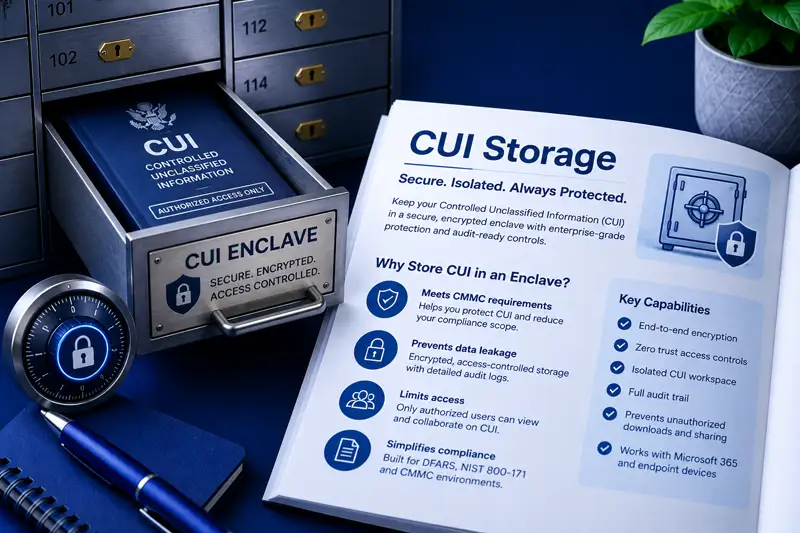
If your organization handles Controlled Unclassified Information for the Department of Defense, the window for “we’ll figure it out later” has officially closed. As of November 10, 2025, CMMC compliance is a binding contract requirement under the 48 CFR Final Rule, not a future checkbox you can defer. The problem most defense contractors face right now is not awareness. It is choosing the right technical foundation without burning six figures on the wrong approach. This article breaks down two leading CUI protection strategies, Microsoft GCC High and PreVeil, shows where each one falls short on its own, and explains how combining them with the right managed compliance layer can cover the full CMMC control set without the complexity of going it alone.
Why Your Cloud Environment Is Now a Contract Requirement
Picture a 30-person manufacturer that has been using Microsoft 365 Commercial for years. Good collaboration tools, familiar interface, reasonable cost. Then a prime contractor adds DFARS clause 252.204-7021 to a new contract, and suddenly that comfortable setup is a compliance liability. The migration to a compliant environment takes months and costs more than anyone budgeted.
This scenario is playing out across the defense industrial base right now. CMMC is fully enforceable. DoD solicitations already include Level 1 and Level 2 requirements, and contractors handling FCI or CUI must maintain continuous CMMC status. A one-time audit is not enough.
The specific problem with Microsoft 365 Commercial is architectural, not cosmetic. Commercial tenants run on global Azure data centers and are administered by personnel who may be located outside the United States. That structure cannot satisfy DFARS 7012 or CMMC Level 2 requirements, regardless of how many security add-ons you bolt on. The environment where CUI lives determines which CMMC controls you can actually demonstrate, and which ones you simply cannot.
Choosing the wrong cloud environment does not just create a compliance gap. It creates a migration problem. Tenant migrations are expensive, disruptive, and time-consuming. Getting this decision right the first time is worth the analysis.
Now that the stakes are clear, the question becomes which compliant environment actually makes sense for your situation, and that depends on understanding what GCC High and PreVeil each do and do not do.
Microsoft GCC High vs. PreVeil: A Straight Comparison
What Microsoft GCC High Covers
Microsoft GCC High is a dedicated sovereign cloud environment: US-only data centers, US-citizen administrators, FedRAMP High authorized. It is the most widely accepted Microsoft path for organizations that need to meet NIST SP 800-171 controls under CMMC Level 2.
In practical terms, GCC High gives you the full Microsoft 365 productivity suite, including Teams, SharePoint, OneDrive, and Exchange, all operating inside a compliant enclave. It covers a broad range of CMMC Level 2 domains: Access Control (AC), Audit and Accountability (AU), Identification and Authentication (IA), Configuration Management (CM), Incident Response (IR), System and Communications Protection (SC), and more. For organizations handling ITAR or EAR-controlled data, or for prime contractors whose subcontractors require a shared compliant collaboration environment, GCC High is typically the right call.
The cost picture has improved, but it is still a step up from commercial pricing. Microsoft launched GCC High Business Premium on November 3, 2025, priced at approximately $36 per user per month for organizations with 300 employees or fewer, a real jump from the $22 per user per month commercial Business Premium tier. Even so, Business Premium runs roughly 45% cheaper per seat than GCC High G3, which lists around $65 per user per month. Year-one total costs for a 20 to 25 user organization have historically reached $100,000 to $120,000 when you factor in implementation, migration, and configuration. The licensing is just the starting point.
Here is the critical limitation: GCC High provides the technical platform, but it does not write your System Security Plan, monitor your environment for threats, or collect audit evidence. As one practitioner put it bluntly, “GCC High doesn’t make you compliant. Your operations do.” The platform is necessary but nowhere near sufficient.
What PreVeil Covers (and Where It Stops)
PreVeil takes a fundamentally different approach. Instead of replacing your existing email and file-sharing infrastructure, it layers an end-to-end encrypted CUI enclave on top of it. No full tenant migration required. It installs as an overlay on your existing tools, which makes deployment relatively fast and low-friction.
The architecture is zero-trust and zero-knowledge, with FedRAMP Moderate authorization as an enclave. PreVeil addresses a focused subset of CMMC controls: primarily Access Control (AC), System and Communications Protection (SC), Media Protection (MP), and Identification and Authentication (IA), specifically around how CUI is transmitted and stored in email and files.
The cost reflects that narrower scope. PreVeil’s Business plan starts at $30 per user per month, with minimal implementation overhead compared to a tenant migration. For a subcontractor with a limited CUI footprint who needs a fast, affordable path to protect CUI in email and file sharing, PreVeil is a genuinely compelling option.
The limitations are equally real. PreVeil does not replace a full productivity suite. If your workflows depend on Teams or SharePoint, those still need separate compliance treatment. PreVeil is not designed for full ITAR compliance. And its CMMC domain coverage is narrower than GCC High by design. It solves a specific problem well. It does not solve all of them.
The comparison makes clear that neither tool alone closes the full CMMC control gap, which raises the practical question of how to stack them effectively and what is still missing even when you do.
The Compliant Stack: Using PreVeil and GCC High Together, and What’s Still Missing
A practical CMMC compliance architecture for a small to mid-size defense contractor often combines both tools by layer. Espresso Labs sits at the foundation of this stack, providing the operational layer that neither platform delivers on its own.
Here is how the layers work together:
| Layer | Tool | What It Covers |
|---|---|---|
| CUI email and file sharing | PreVeil | Encrypted CUI transmission; fast deployment; low cost |
| Full collaboration suite | Microsoft 365 GCC High | Teams, SharePoint, OneDrive in a sovereign cloud |
| Identity and access management | Azure AD / Entra ID via GCC High | MFA, RBAC, Conditional Access (IA, AC domains) |
| 24/7 security monitoring | Espresso Labs | SIEM, endpoint detection, log review (AU, IR, SI domains) |
| Policy, procedures, and evidence | Espresso Labs | Automated playbooks, SSP documentation, audit-ready evidence collection |
| Compliance framework management | Espresso Labs | CMMC control mapping, continuous monitoring, C3PAO assessment readiness |
What neither GCC High nor PreVeil provides on their own is substantial. Neither platform writes or enforces your System Security Plan. Neither monitors your environment around the clock for threats. Neither remediates misconfigurations in real time. Neither organizes audit evidence for C3PAO assessments, which occur every three years and require continuously collected evidence, not a last-minute scramble. Neither maps your controls to CMMC domains automatically.
This is the gap that trips up most organizations. They invest in the right platforms and then discover that the platforms are a foundation, not a finished building. The operational layer, the monitoring, the response, the documentation, the evidence, is where compliance is actually demonstrated or lost.
Understanding the gap between platform and compliance is what separates organizations that pass their C3PAO assessment from those that scramble when the assessor shows up.
FAQ: Common Questions About GCC High, PreVeil, and CMMC
Does CMMC Require Microsoft GCC High?
CMMC does not explicitly mandate GCC High by name, but it does require that CUI be handled in an environment meeting NIST SP 800-171 controls. Microsoft 365 Commercial does not meet that bar for Level 2. GCC High is the most widely accepted Microsoft path for satisfying those requirements. PreVeil is an accepted enclave alternative for contractors with a limited CUI scope. Choosing the wrong environment risks costly tenant migrations and failed assessments, so the decision deserves careful analysis before you commit.
Can PreVeil Replace Microsoft GCC High for CMMC?
No, not in most cases. PreVeil addresses a focused set of CMMC controls around CUI transmission and storage in email and files. It does not cover the full collaboration and productivity surface that GCC High addresses, and it is not designed for ITAR-controlled data. For many subcontractors with a narrow CUI footprint, PreVeil is sufficient as a primary enclave. For prime contractors or organizations with broad CUI workflows involving Teams and SharePoint, GCC High is typically required. Some organizations use both.
What CMMC Controls Does GCC High Not Cover?
GCC High provides the technical platform but leaves operational controls entirely to your organization: policy and procedure documentation, physical security, user training, log review, account lifecycle management, vulnerability remediation, and SSP authorship. These are precisely the gaps where most organizations fail assessments. A managed compliance service fills this space.
How Much Does It Cost to Get Compliant with GCC High?
GCC High Business Premium, launched November 3, 2025, runs approximately $36 per user per month for organizations with 300 employees or fewer, roughly 45% cheaper per seat than GCC High G3. However, year-one total costs for a 20 to 25 user organization have historically reached $100,000 to $120,000 when implementation, migration, and configuration are included, one line item in what CMMC certification costs overall. PreVeil offers a lower entry point, with its Business plan starting at $30 per user per month, making it the more accessible starting point for contractors with limited CUI scope.
How Espresso Labs Helps You Get Compliant, Whichever Path You Choose
Organizations we work with typically arrive with GCC High or PreVeil already in place, or at least a strong opinion about which one they need. What they do not have is the operational layer that makes those platforms actually compliant. That is the gap Espresso Labs closes.
Espresso Labs acts as your virtual IT, cybersecurity, and compliance team, eliminating the need to build internal expertise around GCC High configuration, PreVeil deployment, or the operational controls that neither platform handles automatically. Whether you are running PreVeil as a CUI enclave, migrating to GCC High for full collaboration compliance, or combining both, Espresso Labs maps your CMMC controls to automated playbooks that enforce policies across your entire stack.
The 24/7 security monitoring and threat response that Espresso Labs provides covers the AU, IR, and SI domains that GCC High and PreVeil leave to you to operationalize. Misconfigurations get remediated in real time, not discovered during an assessment. Audit-ready evidence is collected continuously, so when your C3PAO assessment arrives, the documentation exists and is organized, not assembled under pressure.
Espresso Labs also handles day-to-day IT operations and device management, which matters because a misconfigured endpoint can undermine an otherwise solid CMMC posture. And for contractors who serve both government and commercial customers, Espresso Labs supports CMMC alongside SOC 2 and ISO 27001, so your compliance investment covers the full range of requirements your contracts demand.
The argument this article has built comes down to three things you need for CMMC: the right platform, the right operational layer, and continuous evidence collection. GCC High and PreVeil address the first. Espresso Labs delivers the second and third, and helps you choose and configure the first correctly from the start. If you are evaluating your CUI environment or preparing for a C3PAO assessment, that is exactly where a conversation with Espresso Labs begins.