Who Needs CMMC Certification?
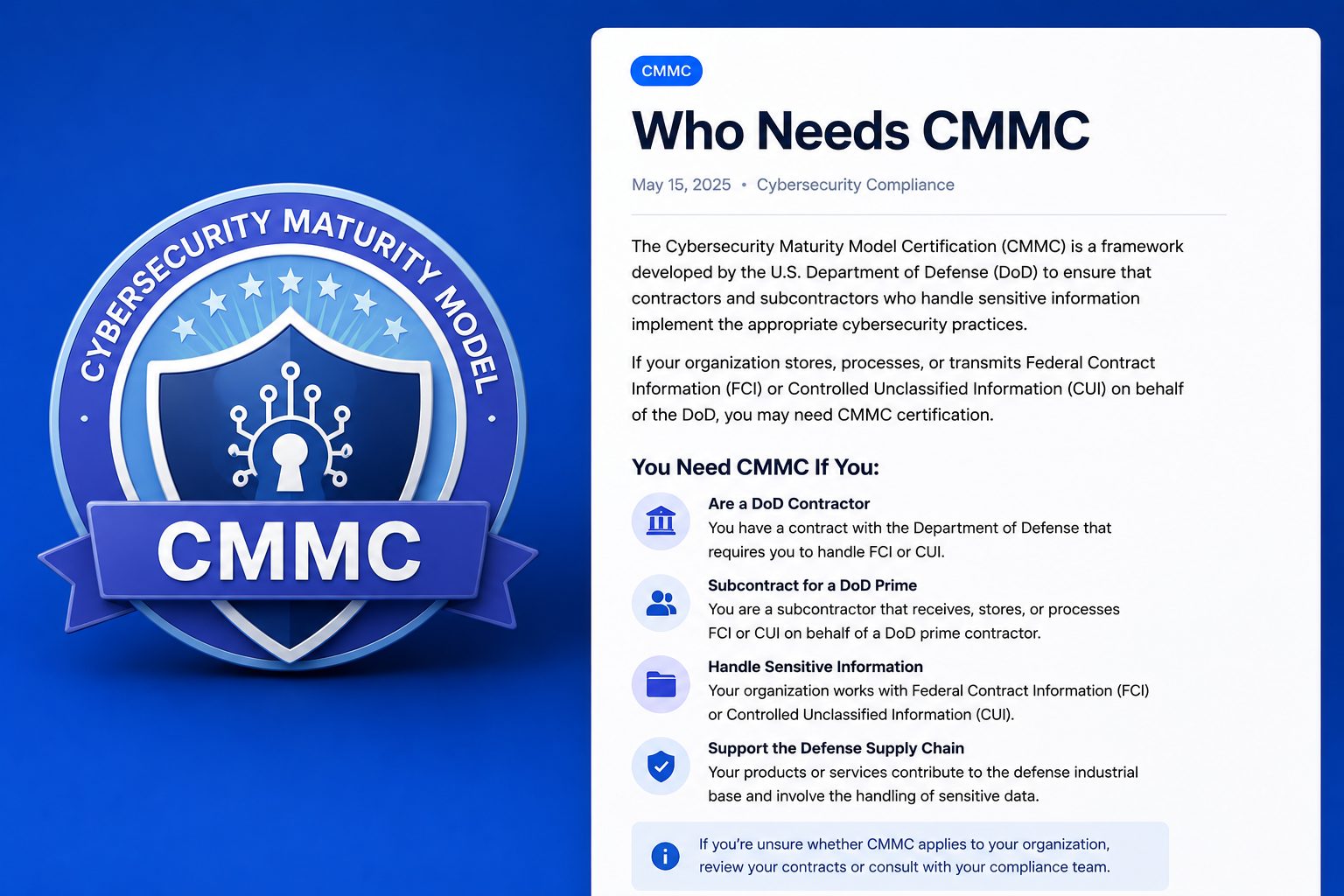
If your organization contracts with the U.S. Department of Defense or subcontracts with a company that does, and you handle FCI or CUI, CMMC applies to you. This isn’t limited to defense primes or aerospace giants. CMMC reaches deep into the supply chain to IT vendors, staffing firms, MSPs, logistics companies, and any business that touches a DoD contract.
What Organizations Need CMMC?
Any organization within the Department of Defense (DoD) supply chain that handles Federal Contract Information (FCI) or Controlled Unclassified Information (CUI) may be required to comply with CMMC. This includes not only prime contractors that work directly with the government, but also subcontractors, suppliers, service providers, manufacturers, software developers, engineering firms, consultants, and other organizations that support defense-related contracts.
CMMC requirements flow down through the supply chain, meaning organizations do not need a direct contract with the DoD to be affected. Whether you manufacture components, develop software, provide professional services, or support a prime contractor in another capacity, handling FCI or CUI may trigger CMMC requirements. As a result, organizations throughout the Defense Industrial Base (DIB) should evaluate their contracts, data flows, and supply chain relationships to determine the level of CMMC compliance required.
Prime Contractors
Direct DoD contract holders handling FCI or CUI. Responsible for flow-down compliance to their entire supply chain.
Subcontractors
Any supplier, vendor, or partner with access to CUI at any tier. Your prime's cert does not cover you.
MSPs & Cloud Providers
Managed service providers and cloud vendors with access to contractor systems or CUI environments.
What CMMC Level is Required?
CMMC applies to companies in the Defense Industrial Base (DIB) that handle Federal Contract Information (FCI) or Controlled Unclassified Information (CUI) as part of DoD contracts.
- CMMC Level 1 is required for organizations that handle only FCI and focuses on basic safeguarding practices; it is typically self-assessed annually.
- CMMC Level 2 applies to companies that process, store, or transmit CUI and aligns with the 110 controls of NIST SP 800-171; depending on the contract, it requires either self-assessment or a third-party certification (C3PAO) and is the level most defense contractors and subcontractors will need.
- CMMC Level 3 is reserved for a smaller subset of companies supporting high-priority or sensitive programs and builds on Level 2 with additional controls from NIST SP 800-172; it requires a government-led assessment.
CMMC requirements are being rolled out through contracts, meaning you need the required level before contract award (or option exercise), not after. As the program is phased in, more solicitations will include CMMC requirements, and primes are already flowing these requirements down to subcontractors. In practice, this means companies should assume they need to be audit-ready now, especially for Level 2, since waiting until a contract requires certification is often too late to implement controls, gather evidence, and pass an assessment in time.
What Happens If You’re Not Compliant With CMMC?
For organizations that require CMMC certification, failing to achieve compliance can have significant business consequences. If a Department of Defense (DoD) contract requires a specific CMMC level, organizations that are not certified will generally be ineligible to bid on, win, or continue performing that work. As CMMC requirements become embedded in more contracts, certification is increasingly becoming a prerequisite for participating in the Defense Industrial Base (DIB).
The impact extends beyond direct government contracts. CMMC requirements flow down through the supply chain, meaning prime contractors are often required to verify that their subcontractors meet the appropriate security requirements. Organizations that delay compliance may find themselves excluded from new business opportunities, lose competitive positioning, and face increased costs as deadlines approach. Starting early allows organizations to address security gaps methodically, avoid last-minute remediation expenses, and ensure they are prepared when certification becomes a contractual requirement.
When is CMMC 2.0 Certification Required?
CMMC 2.0 requirements are being phased into Department of Defense (DoD) contracts over several years. Following the publication of the CMMC 48 CFR Final Rule, CMMC requirements began appearing in new DoD solicitations and contracts, with implementation expanding gradually through a phased rollout. As a result, organizations may encounter CMMC requirements at different times depending on the contracts they pursue and the sensitivity of the information they handle.
A key milestone is expected in November 2026, when the DoD moves into the next phase of the rollout and begins requiring CMMC certification for a broader set of applicable contracts. Over time, CMMC requirements will become increasingly common across the Defense Industrial Base (DIB), impacting both prime contractors and subcontractors that handle Federal Contract Information (FCI) or Controlled Unclassified Information (CUI).
Organizations are strongly advised not wait until a contract requires certification to begin preparing. Achieving CMMC compliance can take many months, particularly for organizations that need to implement new security controls, develop required documentation, remediate gaps, and complete a third-party assessment. Contractors that start early are better positioned to secure assessment dates, avoid certification bottlenecks, and remain eligible for future DoD opportunities.
Which Level Applies To You
Handle FCI Only
You handle FCI but not CUI. Basic commercial work. Annual self-attestation.
Handle CUI
You handle CUI. Most common for defense contractors. Requires C3PAO assessment.
Critical Program
You handle CUI on the DoD's highest-priority programs. Assessed directly by DCMA.
Common Misconceptions
Many organizations delay their CMMC efforts because they assume the requirements do not apply to them. Unfortunately, these misconceptions can lead to lost contract opportunities, rushed compliance projects, and unexpected costs.
“We’re too small to matter.” CMMC requirements apply based on the information your organization handles, not the size of your business. Many small manufacturers, software developers, engineering firms, consultants, and service providers support the Defense Industrial Base (DIB) and may be required to meet CMMC requirements if they handle Federal Contract Information (FCI) or Controlled Unclassified Information (CUI).
“We self-attested before, so we’re already compliant.” Under previous requirements, many organizations were allowed to self-assess and self-attest to their implementation of NIST SP 800-171. CMMC introduces a more rigorous validation process, including third-party assessments for many organizations. A previous self-assessment does not guarantee that your organization will pass a CMMC assessment.
“Our prime contractor will handle compliance for us.” CMMC requirements flow down through the supply chain. While prime contractors are responsible for their own compliance, subcontractors that handle FCI or CUI may also be required to meet specific CMMC requirements. Prime contractors increasingly expect their suppliers and partners to demonstrate compliance before awarding or renewing work.
“Our IT provider stores the CUI, not us.” Outsourcing IT services does not transfer compliance responsibility. If your organization creates, receives, processes, transmits, or has access to CUI, you remain responsible for protecting that information and meeting applicable CMMC requirements. While managed service providers (MSPs), cloud providers, and other vendors can help implement security controls, the contractor ultimately remains accountable for compliance.
The most successful organizations start preparing early, validate their assumptions, and assess their actual CMMC obligations before a contract or customer requires proof of compliance.