GLBA Compliance Checklist (FTC Safeguards Rule)
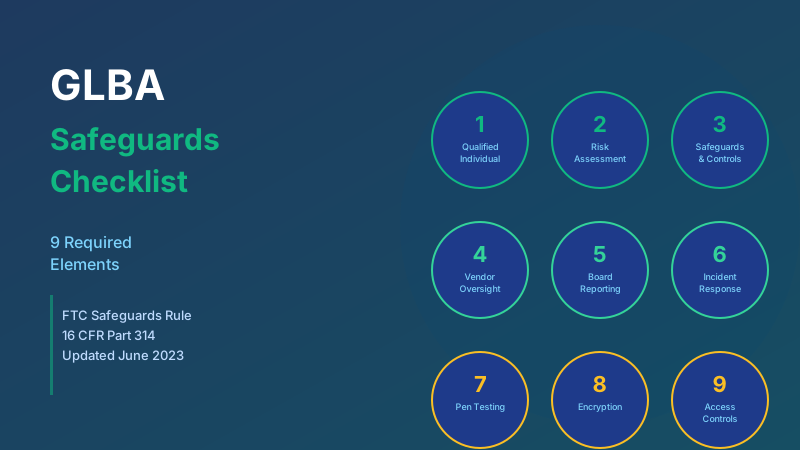
The FTC’s Safeguards Rule (16 CFR Part 314) as updated in 2023 specifies 9 required elements for the information security program that financial institutions must maintain. This checklist helps you assess your current posture against each requirement.
Note: Institutions with fewer than 5,000 customer records are exempt from some specific requirements (marked with *). They still must maintain an information security program and designate a qualified individual.
1. Qualified Individual
- Designated a qualified individual (CISO, CTO, or equivalent) responsible for overseeing the information security program
- The qualified individual has knowledge, skills, and experience appropriate to the role and the institution’s risk profile
- If using a third-party service provider for this role, maintained oversight of their performance
2. Risk Assessment
- Conducted a written risk assessment that identifies:
- Foreseeable internal and external risks to customer information
- Assessment of the sufficiency of existing safeguards
- Criteria for evaluating and categorizing identified risks
- Risk assessment updated whenever material changes to the information security program occur
- Risk assessment results inform the development and maintenance of safeguards
3. Safeguards — Access Controls
- Least privilege: Users have access only to customer information necessary for their job functions
- Multi-factor authentication (MFA) for:
- All remote access to information systems with customer information
- All access to privileged accounts
- Automatic session timeouts after a period of inactivity
- Password controls: Prohibiting common or default passwords, enforcing password strength requirements
4. Safeguards — Data Management
- Customer information inventory: Know what customer information you have, where it is, and who has access
- Data minimization: Only collecting customer information necessary for legitimate business purposes
- Secure disposal: Properly disposing of customer information that is no longer needed for business or legal purposes
- Encryption in transit: Customer information transmitted over external networks is encrypted
- Encryption at rest: Customer information stored on information systems is encrypted (or documented risk-based compensating controls)
5. Safeguards — Change Management
- Change management procedures: Process for tracking and managing changes to information systems
- Secure software development: Pre-implementation security review for internally developed applications
- Inventory of information systems: Maintained and up to date
6. Safeguards — Testing and Monitoring
- Continuous monitoring or periodic testing of safeguards through one of:
- Continuous monitoring of safeguards
- Annual penetration testing AND biannual vulnerability assessments* (*required for 5,000+ customer records)
- Penetration testing: Conducted by qualified internal or external staff, results documented and remediated*
- Vulnerability assessments: Conducted at least every 6 months, including after significant system changes*
- Audit logging: Systems configured to generate and retain logs sufficient to detect unauthorized access
7. Service Provider Oversight
- Written contracts with service providers handling customer information include requirements to:
- Implement appropriate safeguards for customer information
- Notify the institution if they experience a security breach
- Periodic assessments of service providers based on the risk they present and the continued adequacy of their safeguards
- Service provider inventory: Maintained and current
8. Incident Response Plan
- Written incident response plan addressing:
- Goals and scope of the plan
- Internal processes for responding to security events
- Roles and responsibilities
- External and internal communications
- Remediation of vulnerabilities and restoration of services
- Documentation of events and responses
- Post-incident review and program updates
- Plan reviewed and updated at least annually (and after significant incidents)
9. Annual Board Reporting*
(Required for institutions with 5,000+ customer records)
- The qualified individual reports to the board of directors (or equivalent) at least annually on:
- The overall status of the information security program
- Material matters related to the program including risk assessment results, risk management and control decisions, service provider arrangements, testing results, security events, and program recommendations
Additional Regulatory Notification
- FTC breach notification: Following a security breach involving unencrypted customer information of 500+ customers, notify the FTC within 30 days
- Customer notification: Notify affected customers as required under applicable state breach notification laws
How Espresso Labs Helps
Espresso Labs enforces the technical safeguards required by the Safeguards Rule automatically — access controls, MFA, encryption, continuous monitoring, penetration testing, and more — and maintains the documentation your qualified individual needs for board reporting. Contact us to close your GLBA gaps without building a large internal security function.
Sources and further reading