GLBA vs. Other Compliance Frameworks: SOC 2, NY DFS, and More
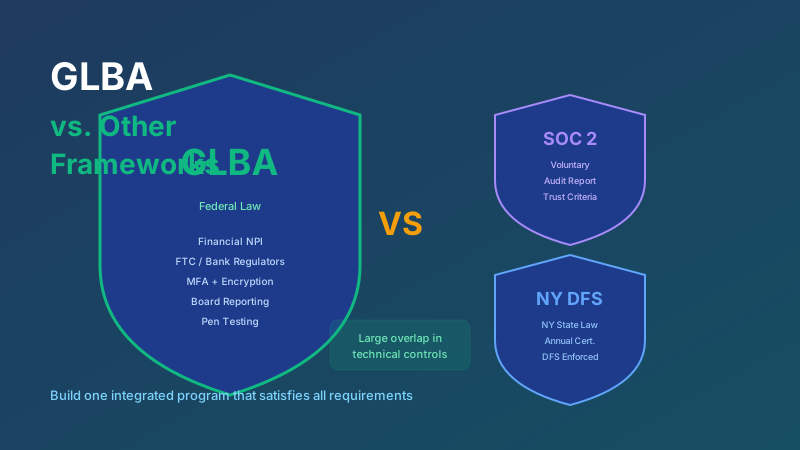
Financial institutions often face multiple overlapping compliance requirements. Understanding how GLBA’s Safeguards Rule relates to other frameworks helps you build an integrated security program that satisfies multiple requirements efficiently — rather than treating each compliance obligation in isolation.
GLBA vs. SOC 2
SOC 2 is an audit framework developed by the American Institute of CPAs (AICPA) that evaluates an organization’s controls around security, availability, processing integrity, confidentiality, and privacy. Unlike GLBA, SOC 2 is voluntary and produces a third-party report (Type I or Type II) that organizations share with customers and partners.
Key differences:
| Dimension | GLBA Safeguards Rule | SOC 2 |
|---|---|---|
| Who requires it | FTC (regulatory) | Customers and partners (market-driven) |
| Scope | Customer financial data (NPI) | Broader (data security, availability, etc.) |
| Output | Regulatory compliance | Third-party audit report |
| Enforcement | FTC penalties | Reputational/commercial |
| Specific controls | Prescriptive (MFA, encryption, pen testing) | Principle-based (Trust Services Criteria) |
Overlap: Both require access controls, encryption, monitoring, incident response, and vendor management. An organization building a GLBA program will satisfy many SOC 2 Trust Services Criteria requirements simultaneously. Many financial institutions pursue SOC 2 alongside GLBA to demonstrate their security posture to enterprise customers.
GLBA vs. NY DFS (23 NYCRR 500)
NY DFS’s 23 NYCRR 500 is the most detailed state cybersecurity regulation in the US and applies specifically to financial services companies operating in New York. For companies operating in New York, both GLBA (federal) and NY DFS (state) may apply simultaneously.
Key differences:
| Dimension | GLBA Safeguards Rule | NY DFS 23 NYCRR 500 |
|---|---|---|
| Jurisdiction | Federal (US-wide) | New York State |
| Enforcer | FTC, bank regulators | NY DFS |
| Annual certification | Not required | Required (February 15) |
| Ransomware reporting | Not required | 24-hour payment notification |
| EDR requirement | Not specified | Required for covered systems |
| PAM requirement | Not specified | Required |
Practical approach: Organizations subject to both should build their program to the NY DFS standard — which is generally more demanding. A NY DFS-compliant program will satisfy GLBA requirements in almost every area, while the reverse is not always true.
GLBA vs. NIST Cybersecurity Framework (CSF)
The NIST CSF is a voluntary framework developed by the National Institute of Standards and Technology that organizes cybersecurity activities around five functions: Identify, Protect, Detect, Respond, Recover. Unlike GLBA, NIST CSF has no enforcement mechanism.
Many organizations use NIST CSF as the structural backbone of their security program, then map specific GLBA Safeguards Rule requirements onto that structure. This approach works well because NIST CSF covers all the functional areas GLBA requires, plus additional depth in areas like supply chain risk and recovery planning.
GLBA and HIPAA
Healthcare finance companies — medical billing services, health insurance companies, health savings account administrators — may be subject to both GLBA and HIPAA. These frameworks have significant overlap in their data protection requirements but different scope and enforcement:
- HIPAA focuses on Protected Health Information (PHI) and is enforced by HHS OCR
- GLBA focuses on customers’ financial information (NPI) and is enforced by the FTC or bank regulators
For covered entities, the data subject to each framework may be different (a health insurer protects both PHI under HIPAA and NPI under GLBA), requiring a unified program that addresses both.
Building an Integrated Program
The most efficient approach for financial institutions with multiple compliance obligations is to build a single security program that satisfies the most demanding applicable framework, with explicit mapping to other requirements. Espresso Labs builds integrated compliance programs that address GLBA, NY DFS, HIPAA, and other applicable frameworks simultaneously — avoiding the cost and complexity of running separate compliance programs for each requirement.
Contact us to see how we can map your specific compliance obligations and build a unified program that satisfies all of them.
Sources and further reading