HITRUST vs. HIPAA: Key Differences, Overlaps, and Which You Need
HITRUST and HIPAA are frequently mentioned in the same breath, but they are fundamentally different in nature and purpose. Understanding the difference helps organizations decide which they need, whether they can achieve one without the other, and how to build a program that satisfies both.
The Core Difference
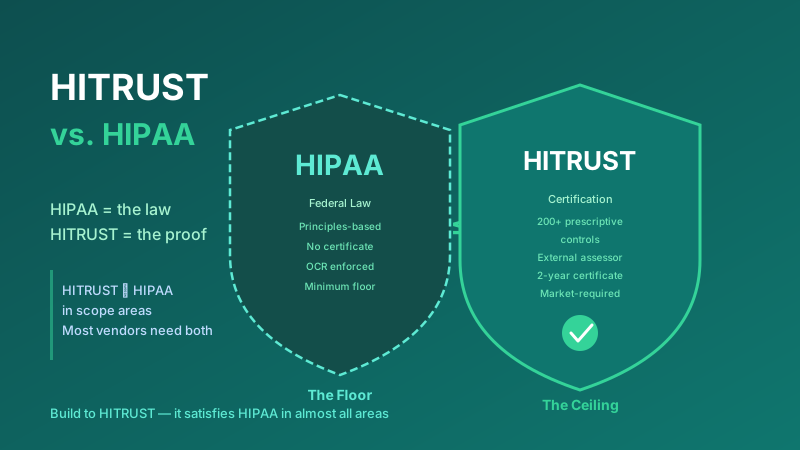
HIPAA (Health Insurance Portability and Accountability Act) is a federal law. Its Security Rule establishes required and addressable specifications for protecting electronic Protected Health Information (ePHI). Covered entities and business associates must comply — it’s not optional. But HIPAA is famously principles-based: it tells you what to achieve without specifying how to do it.
HITRUST is a private certification framework. It provides a comprehensive, prescriptive set of security controls that, when implemented and validated by an external assessor, give healthcare organizations confidence that a vendor meets rigorous security standards. HITRUST is voluntary — but major health systems and payers have made it a contractual requirement, which makes it practically mandatory for many healthcare vendors.
Side-by-Side Comparison
| Dimension | HIPAA | HITRUST |
|---|---|---|
| Type | Federal law | Private certification framework |
| Mandatory? | Yes, for covered entities and BAs | No (but increasingly required by customers) |
| Prescriptiveness | Principles-based | Highly specific controls |
| Assessor | HHS Office for Civil Rights (OCR) | HITRUST-authorized external assessor |
| Output | Compliance status (no certificate) | Certificate valid for 1–2 years |
| Scope | All PHI handling | Systems and controls in defined scope |
| Cost to prove | Low (self-attestation) | High (structured assessment process) |
Does HIPAA Compliance Mean HITRUST Certification?
No. Many organizations have HIPAA compliance programs that are incomplete or insufficiently documented — and a HIPAA-compliant program does not automatically meet HITRUST requirements.
HIPAA sets the floor (the minimum), while HITRUST sets a much higher ceiling. HITRUST includes requirements from NIST, ISO 27001, and industry best practices that go beyond HIPAA’s Security Rule. Examples of controls required by HITRUST that HIPAA doesn’t specifically mandate:
- Endpoint detection and response (EDR) deployment
- Privileged access management (PAM) systems
- Specific vulnerability scanning cadences (at minimum quarterly)
- Annual penetration testing
- Intrusion detection/prevention systems (IDS/IPS)
- Centralized SIEM logging
Does HITRUST Certification Mean HIPAA Compliance?
Largely yes — if your HITRUST scope covers the systems that handle PHI. HITRUST CSF controls map directly to HIPAA Security Rule requirements, and the HITRUST framework was designed to include HIPAA as a subset of its requirements.
However, HITRUST certification does not automatically mean HIPAA compliance for several reasons:
- HITRUST scope may not cover all your PHI-handling systems
- HIPAA also includes Privacy Rule requirements (patient rights, notice of privacy practices) that are not fully covered by HITRUST’s security-focused controls
- HIPAA breach notification requirements have specific timelines and procedures that must be followed regardless of certification status
Which Do You Need?
You need HIPAA compliance if: You are a covered entity (hospital, clinic, insurer) or a business associate (any vendor handling PHI on behalf of a covered entity). This is a legal requirement.
You need HITRUST certification if: A health system, payer, or other customer requires it as a condition of your vendor agreement. This is increasingly common for health IT vendors, telehealth companies, and healthcare SaaS providers.
You may need both: Most healthcare vendors need HIPAA compliance as a legal baseline AND HITRUST certification as a market requirement. Fortunately, a well-structured HITRUST program satisfies HIPAA requirements in almost all areas.
The Practical Approach
If you need both (which most health tech companies do), build your program to the HITRUST standard. A HITRUST-aligned security program:
- Satisfies HIPAA Security Rule requirements
- Gives you a certifiable credential to share with enterprise customers
- Provides a structured framework for continuous improvement
- Reduces the burden of individual customer security questionnaires
How Espresso Labs Helps
Espresso Labs builds integrated HIPAA + HITRUST programs as a managed service — implementing the technical controls required for both, maintaining the documentation needed for HIPAA compliance and HITRUST assessment, and providing ongoing monitoring so you stay compliant between certification cycles. Contact us to discuss your healthcare compliance requirements.
Sources and further reading