Cybersecurity, IT & Compliance for CPA Firms
Know the Risk
CPA firms are no longer just potential targets. They are actively under attack. In just the past year:
- •Accounting firms have been hit with ransomware targeting tax data and client financials, and regulators have fined firms for failing to protect that data and delaying breach notifications (NY Attorney General)
- •Breaches involving CPA firms have exposed thousands of SSNs, tax returns, and financial records
- •The IRS has repeatedly warned that tax professionals are a primary target for cybercriminals (IRS)
Cyberattacks against accounting firms continue to rise, especially during tax season, when urgency and volume make firms more vulnerable.
Why CPA Firms Are Prime Targets
CPA firms carry a critical responsibility to safeguard highly sensitive financial and personal data. They handle tax returns, Social Security numbers, banking details, payroll data, and business financials, making them extremely valuable targets.
This isn't just about best practices — it's a compliance requirement. Under IRS guidelines (Publication 4557), firms must implement and maintain a Written Information Security Plan (WISP) to protect client data. This includes risk assessments, access controls, monitoring, incident response, and ongoing security management.
But in practice, many firms treat WISP as a document, not an operational process. To truly comply, firms need continuous monitoring, timely patching, controlled access, and the ability to respond immediately to threats. Anything less creates real exposure.
Failure to meet these requirements doesn't just increase risk — it can lead to regulatory penalties, liability, and serious reputational damage.
What the IRS and FTC Actually Require in a WISP
Because CPA firms handle taxpayer data, they're treated as "financial institutions" under the Gramm-Leach-Bliley Act, which means the FTC Safeguards Rule applies — and IRS Publication 4557 spells out what that means in practice. A compliant Written Information Security Plan isn't just a document; it requires these controls to be operating continuously:
Designated Security Coordinator
Assign a qualified individual accountable for the firm's information security program.
Written Risk Assessment
Document internal and external risks to client data and how each one is mitigated.
Access Control & MFA
Enforce multi-factor authentication and least-privilege access to tax software and client files.
Encryption
Encrypt client tax data and personally identifiable information at rest and in transit.
24/7 Monitoring & Logging
Monitor systems around the clock and maintain audit logs to detect unauthorized access.
Incident Response Plan
Maintain a written plan for responding to and reporting data breaches, including required notifications.
Employee Training
Train staff annually on data security and phishing recognition, as the WISP requires.
Vendor Oversight
Vet and monitor tax software providers and outsourced service providers with access to client data.
These aren't optional best practices — they're the specific elements the FTC Safeguards Rule and IRS Publication 4557 require every WISP to include. Most small and mid-size firms don't have the internal headcount or toolset to operate them continuously. Espresso Labs does it for you.
The Problem With Traditional Approaches
Most firms addressing these requirements rely on one of three approaches — all of which fall short:
- ✗WISP as a document — written once, often from a template, to satisfy an audit, then never operationalized or updated.
- ✗Seasonal, reactive IT support — support that scales down after tax season, right when systems are still full of sensitive returns.
- ✗Manual access and log reviews — checked quarterly, if at all, instead of continuously.
A WISP nobody enforces isn't compliance, and client data doesn't stop being at risk once tax season ends.
Espresso Labs: 24/7 Coverage
Espresso Labs replaces outdated, reactive IT with a fully operational, AI-powered IT, cybersecurity, and compliance team. We don't just alert you to problems. We detect, investigate, and fix them, automatically and continuously. This allows your small team to do far more, without the need for dozens of IT tools and without the cost of additional headcount.
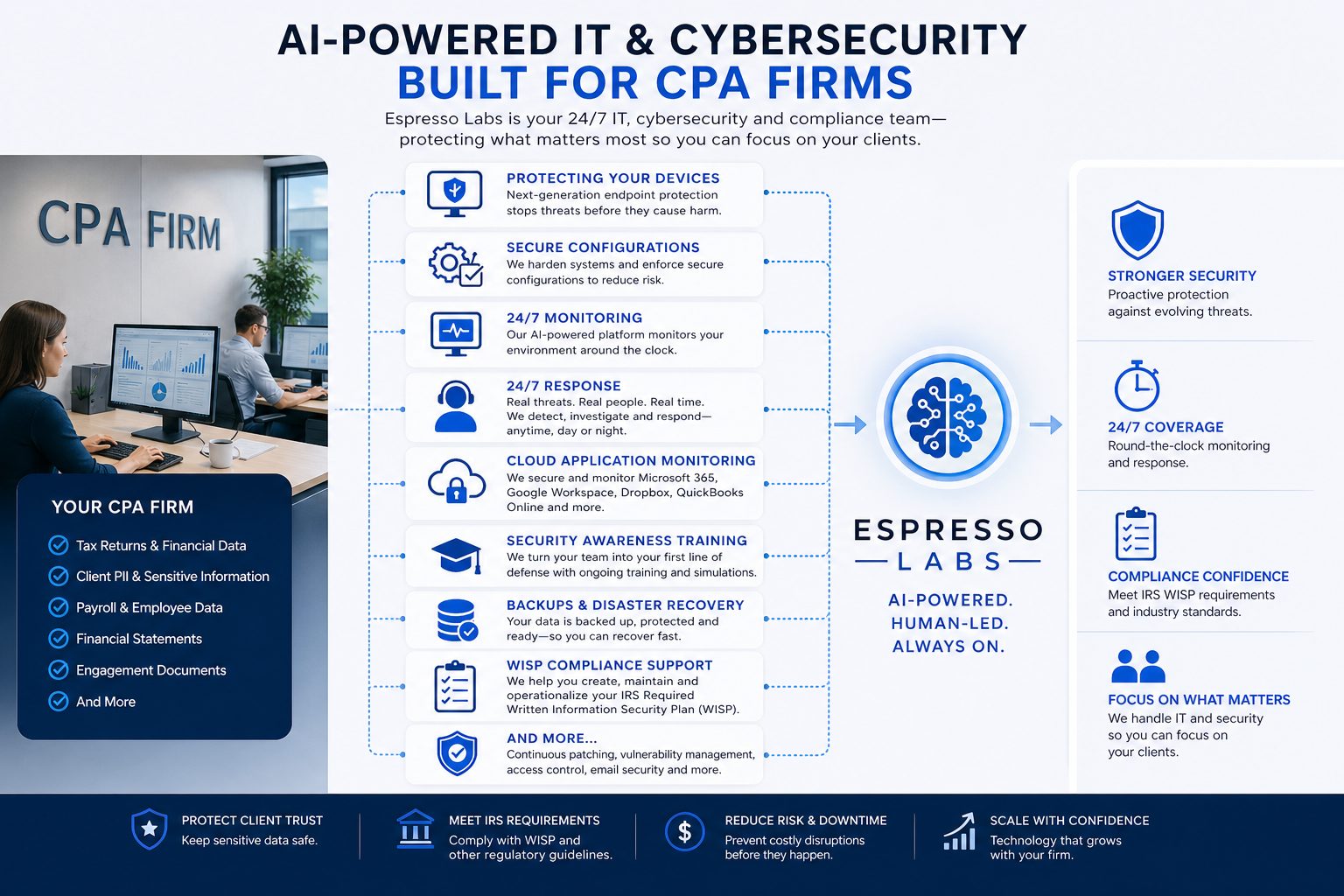
What's Included
A fully managed IT, security, and WISP compliance program for your firm — run continuously, year-round, not just during tax season.
🖥️
Device Management
Remote configuration, patching, and security of every workstation handling client tax data.
🔍
24/7 Monitoring & SOC
Continuous monitoring of systems and tax software environments by AI and human security experts.
🛡️
Endpoint Detection & Response
Real-time detection and containment of malware and ransomware, especially during tax season surges.
🔧
Patch Management
Automatic patching across every device, closing vulnerabilities before they're exploited.
📧
Email Security
Anti-phishing protection against the "new client" and "document request" scams that specifically target tax professionals.
👤
Identity, Access & MFA
Enforced multi-factor authentication and least-privilege access to tax software and client files.
💾
Data Backup & Recovery
Automated backup of client tax data and financial records, with fast recovery from ransomware.
⚡
Incident Response
24/7 incident response and breach notification support to meet IRS, FTC, and state reporting obligations.
Results That Speak for Themselves
CPA firms using Espresso Labs get enterprise-grade security and WISP compliance at a fraction of the cost of building it in-house.
80%
Lower cost than hiring in-house IT and security staff
24/7
Continuous monitoring and response, even during tax season
93%
Fewer disconnected security tools to manage