Managed IT and Cybersecurity for Law Firms
Law firms are increasingly targeted by ransomware, phishing attacks, business email compromise, and data breaches because they store highly sensitive client information. Espresso Labs provides managed IT services, cybersecurity, compliance support, endpoint protection, security monitoring, and incident response for law firms, helping firms protect client data, meet regulatory obligations, and reduce operational risk.
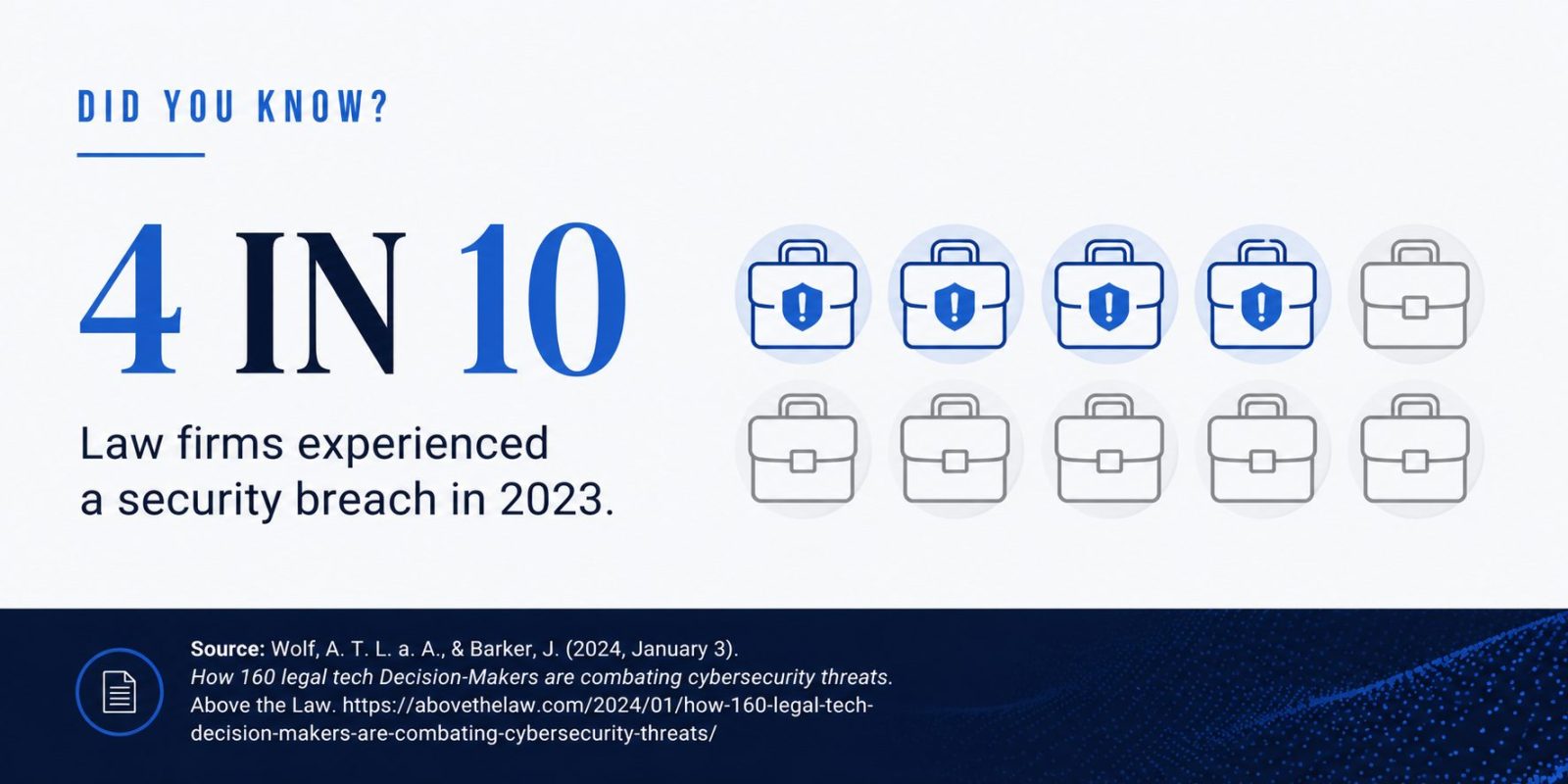
Did you know?
Many law firms don't realize this, but they are no longer just potential targets. They are actively under attack.
In just the past year:
- •A major firm, Jones Day, disclosed a breach where hackers accessed client files following a phishing attack (ABA Journal)
- •Over 300,000 individuals' sensitive data was exposed through a breach involving a law firm handling healthcare records (SecurityWeek)
- •State-sponsored hackers breached a prominent Washington law firm known for representing major political and corporate clients (CNN)
This trend is accelerating, not slowing down. Cyberattacks against law firms surged in 2025, with ransomware campaigns increasingly focused on legal organizations because of the sensitive data they hold and their urgency to resolve incidents quickly.
Why Law Firms Are Prime Targets
Law firms carry a heightened responsibility to protect client data, not just as a best practice but as a core professional obligation. They routinely handle highly sensitive information: intellectual property, financial records, litigation strategy, and personal data. This makes them prime targets for cyberattacks.
Ethical rules around client confidentiality, along with growing regulatory requirements (such as data protection laws and industry-specific standards), require firms to implement strong cybersecurity controls, maintain secure systems, and respond quickly to incidents. This means going beyond policies on paper to continuous monitoring, timely patching, access controls, and documented compliance processes.
Failure to do so doesn't just create operational risk, it can lead to significant liability, reputational damage, and loss of client trust. Attackers know that firms are more likely to pay to avoid exposing privileged information. In fact, Halcyon tracked over 200 ransomware incidents targeting the legal sector between 2025 and early 2026 alone (source).
What Cybersecurity Controls Law Firms Are Actually Required to Have
Cybersecurity for law firms isn't just best practice — it's an obligation. The ABA Model Rules of Professional Conduct require competence in technology (Rule 1.1) and protecting client confidentiality (Rule 1.6). State bars have issued formal ethics opinions on securing client data, outside counsel guidelines from corporate clients increasingly mandate specific technical controls, and state breach notification laws and cyber insurance carriers add their own requirements. Together, these converge on a consistent operational baseline:
Access Control & MFA
Enforce multi-factor authentication and least-privilege access across case management systems, email, and file shares.
Encryption
Encrypt client data at rest and in transit, including documents, communications, and backups.
Email Security
Block phishing, spoofing, and business email compromise attempts targeting wire instructions and client communications.
24/7 Continuous Monitoring
Monitor endpoints, networks, and user activity around the clock to catch intrusions before they spread.
Incident Response & Breach Notification
Maintain a tested incident response plan that meets state breach notification deadlines and client reporting obligations.
Audit Logging
Retain detailed logs of access to client files and privileged communications for accountability and forensic readiness.
Vendor & Third-Party Risk Management
Vet and monitor cloud providers, e-discovery vendors, and other third parties with access to client data.
Security Awareness Training
Train attorneys and staff to recognize phishing, social engineering, and wire fraud schemes.
Most small and mid-size firms don't have the internal headcount or toolset to operate these controls continuously. Espresso Labs does it for you.
The Problem With Traditional Approaches
Most firms addressing these requirements rely on one of three approaches — all of which fall short:
- ✗Traditional MSPs — billed hourly or per-ticket, with support limited to business hours. An alert at 5pm Friday waits until Monday.
- ✗Disconnected point solutions — antivirus, backup, and email filtering bought separately, none of it monitored or tied together, leaving gaps attackers exploit.
- ✗Manual compliance — policies written once and filed away, with no one continuously verifying that access controls, patching, and logging are actually happening.
Client data doesn't stop being at risk after 5pm, and a compliance policy nobody enforces isn't compliance.
The Reality: Traditional IT Isn't Built for This
Most law firms still rely on:
- •Reactive IT providers
- •Disconnected security tools
- •Manual compliance processes
Most importantly, what happens when an alert hits at 5pm on Friday? Is anyone there to see it, understand it, or act on it? When alerts go unanswered, patches are delayed, and urgent issues aren't addressed in real time, everything else becomes ineffective.
Espresso Labs: A Different Approach
Espresso Labs replaces outdated, reactive IT with a fully operational, AI-powered IT, cybersecurity, and compliance team, built specifically for environments like law firms where downtime and data exposure are unacceptable.
We don't just alert you to problems. We detect, investigate, and fix them, automatically and continuously. This allows your small team to do far more, without the cost of additional headcount.
What's Included
A fully managed IT, security, and compliance program for your firm — run continuously, not assessed once a year.
🖥️
Device Management
Remote configuration, security, and lifecycle management of every laptop and workstation across the firm.
🔍
24/7 Monitoring & SOC
Continuous monitoring of endpoints, network, and cloud environments by AI and human security experts.
🛡️
Endpoint Detection & Response
Real-time detection and automatic containment of malware and ransomware before it spreads.
🔧
Patch Management
Automatic patching of operating systems and software across every device, closing vulnerabilities before they're exploited.
📧
Email Security
Advanced anti-phishing and business email compromise protection for the #1 attack vector against law firms.
👤
Identity, Access & SSO
MFA enforcement, single sign-on, and least-privilege access across case management and file systems.
💾
Data Backup & Recovery
Automated backup of client files and case data, with fast recovery in the event of ransomware.
⚡
Incident Response
24/7 incident response, containment, and breach notification support to meet state and client reporting deadlines.
Results That Speak for Themselves
Law firms using Espresso Labs get enterprise-grade security and compliance coverage at a fraction of the cost of building it in-house.
80%
Lower cost than hiring in-house IT and security staff
24/7
Continuous monitoring, response, and control enforcement
93%
Fewer disconnected security tools to manage
Frequently Asked Questions
Why do law firms need cybersecurity services?
Law firms are frequent targets for cyberattacks because they store highly sensitive client information, financial data, and confidential legal documents. Effective cybersecurity helps protect client confidentiality, reduce risk, and prevent costly business disruptions.
What are the biggest cybersecurity risks facing law firms?
Common threats include ransomware, phishing attacks, business email compromise, data breaches, insider threats, and unauthorized access to client information. Even a single incident can result in financial loss, reputational damage, and significant legal liability.
How can law firms protect confidential client information?
Most law firms rely on a managed service provider (MSP) to deliver essential IT and cybersecurity services, including 24/7 security monitoring, endpoint management, patch management, backup and recovery, and user support. This approach helps firms maintain a strong security posture, protect confidential client information, and ensure business continuity while allowing attorneys to focus on serving their clients.